

A full-service catering package typically covers food by course (appetizers through dessert), professional staffing, delivery, setup and breakdown, basic serving equipment, and some form of beverage service. That’s the short version. The longer version is that what’s actually in your contract depends heavily on the service level you choose, and the gap between a drop-off quote and a full-service quote can be $25–$50 per person before you’ve added a single rental.
Quick TL;DR: A catering package includes food, staff, equipment, and logistics. The exact mix depends on the service tier. Always compare proposals line by line, not just per-person price.
- Food: appetizers, mains, sides, desserts, and portioning guidance
- Staffing: event manager, chefs, servers, and bartenders (varies by tier)
- Logistics: delivery, setup, food warming, and post-event cleanup
- Equipment: serving ware, chafing dishes, beverage dispensers, coffee urns
- Beverages: soft drinks, coffee service, or full bar (often priced separately)
- Extras that usually cost more: china, linens, specialty glassware, overtime
Pro Tip: Always request an itemized proposal that breaks out menu, rentals, labor, service fees, taxes, and gratuity as separate line items. A bundled quote makes it nearly impossible to compare vendors fairly.
Table of Contents
- What types of catering packages are there?
- What does a catering package include, line by line?
- How does catering pricing actually work?
- How do you compare catering packages fairly?
- What add-ons and upgrades usually cost extra?
- Sample package setups by event type
- What do experienced caterers and planners actually recommend?
- Key Takeaways
- The vendor’s view: why line items matter more than you think
- When corporate delivery is the smarter call
- Useful sources and further reading
What types of catering packages are there?
The service level you pick shapes everything else: cost, staffing, formality, and what you’re responsible for on the day. Here’s how the main package types stack up.
Drop-off / delivery: The caterer prepares the food and delivers it, period. No staff, no setup beyond dropping off containers, and definitely no cleanup. Drop-off catering suits office meetings, casual team lunches, and any event where you have staff on-site to manage service. Budget roughly $12–$20 per person for this tier.
Buffet / self-serve: Food is arranged on a buffet line with chafing dishes and serving utensils. A small crew typically sets up and breaks down, but guests serve themselves. This is the most popular format for corporate events and casual celebrations because it balances cost and convenience. Expect a mid-range price in the $20–$50 per person range, varying by menu complexity.

Plated / full-service: Servers bring each course to seated guests. This format requires the most staff, the most coordination, and the highest per-person spend, but it’s the standard for weddings and formal galas. Full-service catering covers delivery, on-site chefs, servers, bartenders, and cleanup, starting at $50+ per person.
Action stations / interactive stations: Carving stations, pasta bars, taco bars, sushi rolls made to order. Stations add energy to a room and work well for cocktail hours or corporate galas where mingling matters more than a seated format.
Food trucks: A self-contained unit that handles prep, service, and its own cleanup. Popular for outdoor events and company picnics. Pricing typically falls in the $20–$50 per person range, though minimums vary widely by market.
Corporate / office delivery: A specialized drop-off model built for recurring office needs. Sandwich platters, boxed lunches, and meeting trays delivered on a tight schedule with minimal administrative overhead. Ideal for team meetings, training days, and working lunches.
| Service Type | Typical Inclusions | Usually Excluded |
|---|---|---|
| Drop-off | Food, disposable serving items | Staff, setup, cleanup |
| Buffet | Food, setup, small crew, chafing dishes | Full staffing, premium rentals |
| Full-service plated | Food, full staff, equipment, cleanup | High-end china, specialty linens |
| Action stations | Food, station staff, equipment | Seating, full table service |
| Food truck | Food, service, self-cleanup | Staffing for other event needs |
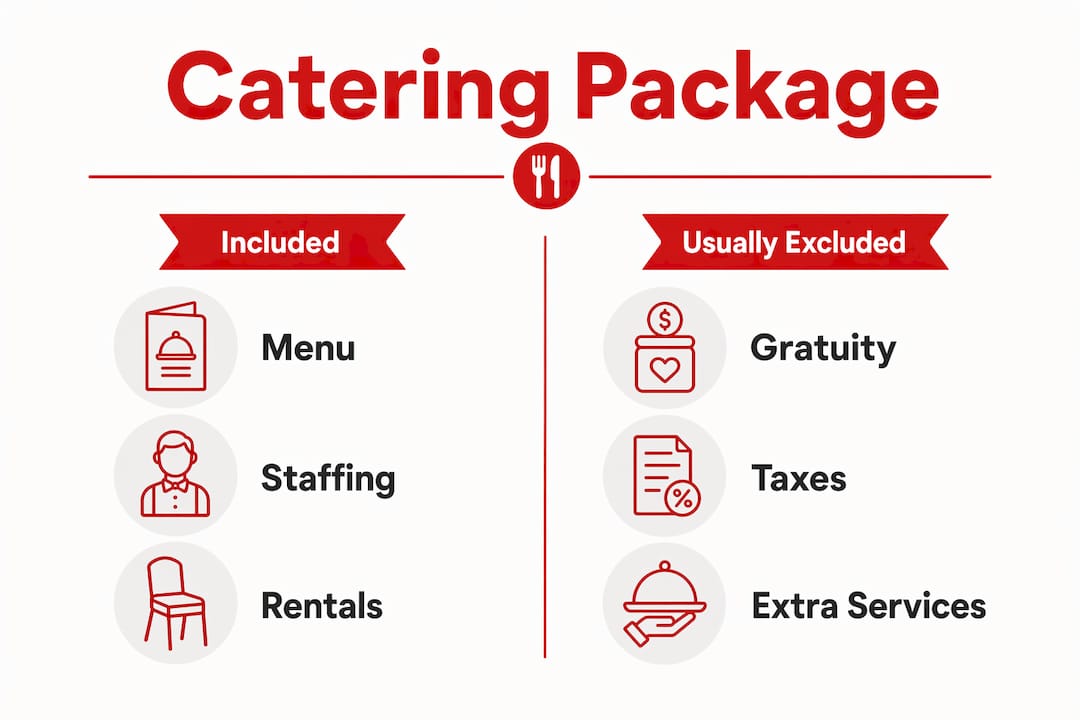
What does a catering package include, line by line?
This is the section to bookmark before you review any proposal. A comprehensive catering package typically covers menu planning, food preparation, professional staffing, and operational support. Here’s what each category actually means in practice.
Menu planning and food
Most packages let you choose from a set of sample menus, then customize within that framework. A full-service package covers:
- Appetizers: passed hors d’oeuvres, charcuterie, or a cocktail-hour spread
- Main courses: protein options (chicken, beef, fish, vegetarian), typically two choices for plated service
- Sides: starches, vegetables, salads, and bread service
- Desserts: often a separate line item; cake cutting is almost always extra
- Portion guidance: a reputable caterer will advise on quantities per guest based on event length and service style
Tastings are standard for weddings and larger events. Confirm whether the tasting is included in the package price or billed separately.
Staffing
| Role | Drop-off | Buffet | Full-service |
|---|---|---|---|
| Event / catering manager | No | Sometimes | Yes |
| On-site chef | No | Sometimes | Yes |
| Servers | No | 1 per 25–30 guests | 1 per 8–10 guests |
| Bartenders | No | Optional | Yes (if bar included) |
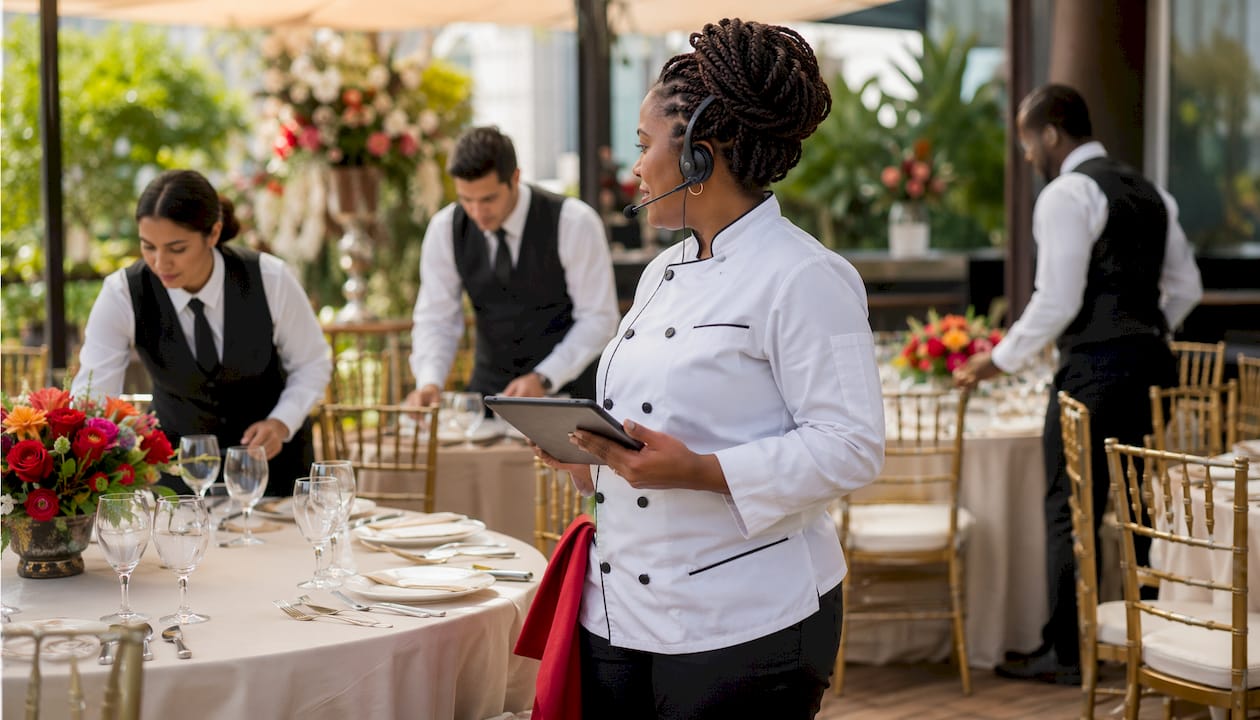
A standard rule of thumb for plated service is one server per 8–10 guests; buffets typically run one per 25–30 guests. Ask your caterer to state the ratio in writing.
Operational support
Standard inclusions across most mid-tier and full-service packages:
- Delivery to the venue within an agreed window
- Setup of food stations, buffet lines, or plated service areas
- Warming equipment: chafing dishes, fuel, and food-safe holding containers
- Beverage stations: water dispensers, coffee urns, juice pitchers
- Post-event breakdown and cleanup of catering areas
What most caterers provide as standard includes serving platters, bowls, warming equipment, and basic beverage dispensers. High-end china, crystal glassware, and specialty linens are almost always separate rental line items.
Rentals: included vs. extra
- Usually included: serving ware, chafing dishes, serving utensils, basic beverage dispensers
- Usually extra: china plates, flatware, cloth napkins, specialty glassware, tablecloths, chiavari chairs, specialty furniture
When booked separately, rentals can add $3–$10 per guest to the total. Confirm with your venue what they already supply before signing anything.
Beverage and bar service
Soft drinks and coffee are often bundled into mid-tier packages at a small per-person cost ($1–$3 per guest). A full open bar is almost always a separate add-on, typically adding $20+ per guest. If you’re supplying your own alcohol, ask about the corkage policy upfront, as fees vary significantly by caterer.
Dietary accommodations
Professional caterers recommend building dietary accommodations into the menu from the first consultation rather than treating them as last-minute requests. Vegetarian, vegan, and gluten-free options should be budgeted and planned alongside the main menu. Ask specifically about cross-contamination protocols and whether special meals will be labeled at service.
Trust and contract items to confirm
- Itemized proposal with separate line items for food, staffing, rentals, and fees
- Proof of general liability insurance and food-safety permits
- Cancellation and force majeure terms
- Overtime rates (what happens if the event runs long)
- Gratuity policy (included, expected, or at the client’s discretion)
Pro Tip: Treat the proposal as a personalized document, not a public rate card. Assume linens, china, and flatware are separate until the caterer confirms otherwise in writing.
How does catering pricing actually work?
The per-person menu price is the starting point, not the finish line. Here’s how the real number gets built.
Base food cost covers ingredients, prep labor, and the menu itself. This is the figure most caterers lead with in marketing materials.
Service and production fees are where many planners get caught off guard. These fees, which typically run 18–22% of the food and beverage total, cover administrative overhead, culinary prep time, truck loading, fuel, and delivery logistics. They are not gratuity.
Taxes are applied on top of the subtotal and commonly run 7–9% in many U.S. locations, though rates vary by state and county.
Gratuity is separate again, either included as a fixed percentage or left to the client’s discretion. Some contracts add 18–20% gratuity on top of the service fee and taxes, which can push the final invoice 40–50% above the per-person menu price.
Other cost drivers to factor in:
- Staffing hours: overtime kicks in when events run past the contracted window
- Rentals: china, linens, and specialty equipment priced per item or per guest
- Bar type: beer and wine service costs less than a full open bar
- Minimum guest counts: most caterers set a floor (often 50–100 guests for full-service)
- Travel and delivery fees: especially relevant for venues outside the caterer’s primary service area
A rough comparison: a drop-off lunch for 50 people at $15 per person runs $750 in food before fees. The same event with buffet service at $30 per person, plus a 20% service fee and 8% tax, lands closer to $1,944 before gratuity. Full-service plated at $50 per person for the same group, with the same fee structure, comes to $1,800 plus fees. The catering logistics behind each tier explain why the gap is that wide.
How do you compare catering packages fairly?
Use this sequence on every vendor call and when reviewing formal proposals.
- What is your minimum guest count, and what happens if attendance drops? A reasonable answer names a floor and explains the adjustment policy.
- What is the staff-to-guest ratio for my service style? Get this in writing; vague answers lead to understaffed events.
- What rentals are included, and what are priced separately? Ask for a line-item list, not a yes/no answer.
- What is your corkage policy if I supply my own alcohol? Fees range from zero to $15+ per bottle.
- What does the tasting cover, and is it included in the package price? Some caterers charge for tastings; others apply the cost to the final invoice.
- What are your overtime rates? Know the per-hour or per-half-hour charge before you sign.
- What are your cancellation and force majeure terms? Confirm deposit refund timelines and what triggers a full forfeit.
- Can you provide proof of general liability insurance and food-safety permits? Any reputable caterer has both and will share them without hesitation.
- What is your delivery window, and what happens if you arrive late? Confirm the guaranteed arrival time and any remedy for delays.
- When is the final guest count due, and what is the payment schedule? Most caterers lock the count 5–10 days before the event; payment schedules vary.
A good catering checklist for event planners covers these points and more. Use it alongside your vendor calls.
Red flags to watch for in proposals:
- Vague “production fee” with no breakdown of what it covers
- Missing insurance documentation or a reluctance to provide it
- No stated overtime rate
- Rentals listed as “included” without specifying which items
- No cancellation terms or a clause that forfeits the full deposit immediately
Before signing, confirm: itemized quote, deposit terms, insurance proof, food-safety permits, and liability coverage. Coordinating with your venue early also prevents paying for duplicate rentals. Venue inventory often includes tables, chairs, or basic kitchen equipment that can reduce your catering scope.
What add-ons and upgrades usually cost extra?
Base packages cover the essentials. Everything below is typically a separate line item, and the costs add up faster than most planners expect.
- Upgraded linens: floor-length tablecloths, specialty colors, or textured fabrics in place of standard white
- Premium china and flatware: porcelain plates and real silverware instead of basic serving ware
- Specialty glassware: crystal wine glasses, champagne flutes, or branded barware
- Chiavari chairs or specialty furniture: standard folding chairs are often included; anything else costs extra
- Cake cutting service: almost universally a separate charge, often $1–$3 per guest
- Espresso or specialty coffee bar: a staffed espresso station adds roughly $3–$8 per person
- Dessert stations: macaron towers, donut walls, or a staffed crepe station
- Late-night snack service: sliders, fries, or pizza at hour four of a wedding reception
- Themed food stations: taco bars, raw bars, carving stations with a dedicated attendant
- Extended bar service: adding hours beyond the contracted window at an hourly rate
For a practical look at catering package ideas that bundle some of these add-ons, industry resources can help you see which upgrades are worth the spend for your event type.
Sample package setups by event type
| Event Type | Service Style | Typical Per-Person Range | What’s Usually Included |
|---|---|---|---|
| Wedding (100 guests) | Full-service plated | $50+ per person | 3-course meal, full staff, china, bar, cleanup |
| Corporate gala | Stations + full bar | $20–$50 per person | 4–5 stations, bartenders, event manager, cleanup |
| Company meeting (20–50 people) | Buffet or delivery | $12–$30 per person | Food, basic setup, disposable or basic serving ware |
| Backyard party (30 guests) | Buffet or food truck | $20–$50 per person | Food, self-service setup, limited or no staff |
Weddings carry the highest per-person cost because plated service demands more staff hours, premium rentals, and tighter coordination. A corporate gala with stations can run nearly as high once a full bar is added. Company meetings and office lunches are where corporate menu curation and delivery-focused models genuinely shine: the cost stays predictable, the admin is minimal, and you don’t need a catering manager on-site.
Savings typically come from choosing self-serve formats, simplifying the menu to fewer courses, reducing staff hours, and skipping the open bar. Costs rise with plated service, premium ingredients, specialty rentals, and any bar package beyond beer and wine.
What do experienced caterers and planners actually recommend?
The most consistent advice from industry professionals comes down to one thing: transparency at the proposal stage prevents almost every dispute that happens later.
Caterers recommend requesting a personalized, itemized proposal that separates menu, staffing, rentals, bar service, setup and breakdown, and all fees. A bundled quote is not a quote; it’s a starting point for a negotiation you’re not equipped to have without the line items.
On dietary accommodations, the standard professional advice is to raise every restriction at the first consultation, not after the menu is set. Special meals need to be budgeted, sourced, and labeled at service. Asking about cross-contamination protocols matters especially for guests with severe allergies, since a kitchen that handles nuts throughout the day may not be able to guarantee a nut-free plate without specific procedures in place.
Pro Tip: Before finalizing any contract, ask your venue coordinator which tables, chairs, and kitchen equipment they supply. Confirming that list with your caterer prevents duplicate rental charges and can meaningfully reduce your total.
When events require multiple vendors, full-service catering often reduces overall cost and logistical risk by consolidating staffing and coordination under one provider. The savings come not from a lower per-person price but from fewer moving parts, fewer vendor calls, and fewer opportunities for something to fall through the cracks on the day.
For a deeper look at how catering packages are designed to book efficiently, the operational perspective from caterers themselves is worth reading before you finalize your brief.
Key Takeaways
A catering package’s real cost is always higher than the per-person menu price once service fees, taxes, rentals, and gratuity are added. Get every line item in writing before you commit.
| Point | Details |
|---|---|
| Always get an itemized proposal | Separate menu, staffing, rentals, fees, taxes, and gratuity to compare vendors fairly. |
| Confirm staff ratios and overtime | Ask for the staff-to-guest ratio in writing and know the per-hour overtime rate before signing. |
| Verify rental inclusions | Assume china, linens, and flatware are extra until the caterer confirms otherwise in writing. |
| Budget for service fees and taxes | Production/Service fees typically run 18–22% of the food and beverage total; taxes often add 7–9% more. |
| Theofficelunch for corporate events | For office meetings and team lunches, Theofficelunch offers predictable delivery-focused catering without full-service overhead. |
The vendor’s view: why line items matter more than you think
Turning an event inquiry into a proposal takes more work than most clients realize. A catering team factors in guest count, service style, venue access, staffing hours, travel time, equipment needs, and dietary requirements before a single price appears on paper. That’s why two proposals for the same guest count can look completely different: one caterer may bundle everything into a per-person rate, while another breaks it into eight separate line items.
Production fees exist because the visible cost of food is only part of what a caterer delivers. Administrative time, culinary prep before the truck is loaded, fuel, and post-event logistics all have real costs. The problem isn’t that these fees exist; it’s when they’re buried in a single line labeled “production” with no explanation. A caterer who won’t break that down is not a caterer you want managing your event.
One practical move that saves money and avoids friction: call your venue coordinator before you finalize any catering contract. Many venues supply tables, chairs, or kitchen equipment that your caterer would otherwise rent and charge back to you. Confirming that list early, then sharing it with your caterer, can remove several line items from the invoice entirely. For corporate planners managing recurring events, a corporate event catering timeline helps keep those coordination steps from falling through the cracks.
When corporate delivery is the smarter call
Full-service catering is the right answer for weddings, galas, and formal dinners. For a Tuesday team lunch or a 20-person strategy session, it’s often the wrong tool for the job.

Theofficelunch is built specifically for the corporate scenario where speed, predictability, and low admin overhead matter more than white-glove service. Fresh sandwich platters, boxed lunches, and meeting trays delivered on a fixed schedule, with menu options that cover dietary needs without requiring a separate consultation. No event manager to coordinate, no rental invoice to reconcile, no overtime clause to worry about.
For offices in London and Surrey, office catering from Theofficelunch keeps recurring team meals simple: order from a clear menu, get delivery at the right time, and get back to work. If you need to see the full menu before committing, the sandwich platter options are a practical starting point. Get a quote today and see how straightforward corporate catering can be.
Useful sources and further reading
- What Does a Catering Package Include in Seattle? (Kaspar’s Catering) — Supports the BLUF and line-by-line inclusions checklist.
- What’s Typically Included in Wedding Catering Packages (Hugh’s Catering) — Rental vs. included equipment and dietary accommodation guidance.
- What’s Included in Full-Service Catering? (Foodstuffs Catering) — Package type comparisons and the cost-consolidation argument for full-service.
- Catering Packages for 100 Guests: Pricing Guide (Eventory) — Per-person price ranges, add-on cost cues, and rental estimates.
- Wedding Catering Packages With Prices: Planning Guide (Cafe Natalie) — Service fee structures, itemized proposal guidance, and venue coordination advice.
- Theofficelunch: Office Catering London — Primary landing page for corporate and office catering delivery in London and Surrey.
Recommended
- Catering Checklist Guide for Event Planners in 2026 – Sandwich platters – Office Lunch – Catering company-Party food
- Catering Brief for Corporate Events: 2026 Guide – Sandwich platters – Office Lunch – Catering company-Party food
- Event Catering Logistics: What Corporate Planners Need to Know – Sandwich platters – Office Lunch – Catering company-Party food
- How Catering Supports Business Celebrations That Work – Sandwich platters – Office Lunch – Catering company-Party food