

Supplies made in the course of catering are normally taxed at the standard VAT rate, whether the food is eaten on site, delivered to an office, or served at an event. Retail food sales are often zero-rated, but catering never qualifies for that exemption. The one exception right now: a temporary 5% reduced rate applies to qualifying children’s meals from 25 June 2026 to 1 September 2026. Certain items like alcohol and confectionery stay standard-rated regardless.
TL;DR:
- Most catering supplies are taxed at the standard VAT rate of 20%, with only a temporary 5% rate applying to qualifying children’s meals from June to September 2026.
- The VAT treatment depends on objective tests such as the purpose, location, temperature at supply, and whether the food is for immediate consumption, rather than the business’s label.
- Hot food supplied hot at the point of sale is always standard-rated, while reheated or cold items may vary depending on specific operational details.
- Alcohol, confectionery, hot drinks, ice cream, and soft drinks never qualify for zero-rating, regardless of sales context or packaging.
- Clear, detailed invoicing and precise recordkeeping—especially distinguishing catering from retail sales—are crucial to ensure compliance and avoid errors during VAT rate changes or audits.
Table of Contents
- What Counts as “In the Course of Catering” Under UK Catering VAT Rules
- Catering VAT Percentage UK: A Quick Reference by Supply Type
- Hot vs Cold Takeaway: The Practical Tests That Decide Your Rate
- Food and Drink That Never Qualifies for Zero-Rating
- The Temporary 5% Rate for Children’s Meals: What Changes This Summer
- Applying These Rules to Office Catering and Corporate Lunch Delivery
- A Step-by-Step Checklist for Charging and Recording Catering VAT
- Mixed Supplies: Event Packages That Bundle Venue and Food
- VAT Invoicing Requirements Specific to Catering Businesses
- Record-Keeping for VAT Compliance in Catering
- How VAT Rate Changes Affect Contracts and Pricing
- Why Most Businesses Overcomplicate This
- Sources
What Counts as “In the Course of Catering” Under UK Catering VAT Rules
HMRC does not tax “catering” because of who cooked the food. It taxes catering because of how, where, and why the food gets supplied. VAT Notice 709/1 sets out the legal basis for excluding catering supplies from the zero-rating that applies to most retail groceries, and that exclusion is the entire reason this topic trips up so many small food businesses.
Rather than a single definition, HMRC applies a set of objective tests to work out whether a supply falls “in the course of catering.” These tests look past what the business calls the transaction and focus on the practical reality of the sale.
- Purpose of the supply. Was the food prepared and delivered for a specific event, meeting, or occasion, rather than sold as a standalone grocery item?
- Where it was prepared. Food made to order for a particular customer or event points toward catering, not retail.
- Whether it’s supplied hot. Heat at the point of supply is one of the strongest indicators HMRC uses.
- Immediate consumption. If the food is packaged and priced for eating straightaway, that leans toward catering treatment.
Office catering sits squarely in this territory and understanding the different service models for hospitality providers can help clarify its operational distinctions. A sandwich platter delivered for a 10 a.m. board meeting is catering: it’s prepared for a specific occasion, delivered at a set time, and meant to be eaten right away. A buffet set up for a corporate event follows the same logic. The one gray area is bulk supply between businesses, covered further down, where a wholesale sandwich order sold on to another retailer for resale can sometimes escape the catering label entirely.
Catering VAT Percentage UK: A Quick Reference by Supply Type
Most confusion around the catering VAT percentage in the UK comes from assuming one rate covers everything. It doesn’t. Three separate treatments apply depending on what’s sold and how.
The standard rate covers the vast majority of catering supplies, including office lunch deliveries, event buffets, and any food served hot for immediate consumption. Zero-rating covers most basic groceries sold for people to prepare at home, but that exemption stops the moment a supply crosses into catering territory. The temporary 5% rate is narrow by design: it applies only to qualifying children’s meals supplied in the course of catering between 25 June and 1 September 2026, and it does not extend to adult portions or general hospitality sales.
| Supply Type | VAT Treatment | Note |
|---|---|---|
| Sandwich platter delivered to an office meeting | 20% standard | Catering supply, prepared for a specific occasion |
| Cold groceries sold in a supermarket | 0% zero-rated | Not catering; sold for home preparation |
| Qualifying children’s meal, eaten on premises (25 June–1 Sept 2026) | 5% temporary reduced | Must meet the brief’s conditions |
| Hot takeaway meal | 20% standard | Hot at point of supply |
| Alcoholic drinks served at a catered event | 20% standard | Always standard-rated, no exceptions |
| Bulk sandwich order resold by another trader | 0% zero-rated (case dependent) | Only if not made “in the course of catering” |
Businesses handling event packages, mixed menus, or seasonal promotions should treat this table as a starting point, not a substitute for checking each supply against HMRC’s own tests.
Hot vs Cold Takeaway: The Practical Tests That Decide Your Rate
The “hot food rule” causes more disputes than any other part of UK catering VAT rules, largely because the line between a hot meal and a chilled platter that happens to get reheated later isn’t always obvious on paper. VAT Notice 701/14 sets out HMRC’s approach: food that is hot at the point of supply, and supplied for the purpose of being eaten hot, is standard-rated. It doesn’t matter whether the customer eats it immediately or lets it cool on the drive back to the office.
This is where small operational details end up mattering more than most business owners expect. How the food is packaged, whether the seller markets it as a “hot meal,” and whether heat-retaining containers are used can all factor into how HMRC’s internal guidance treats a borderline case, according to HMRC’s excepted items manual.
For office and event catering, three scenarios come up constantly:
- Hot meals delivered to an office or event. Standard-rated at 20%, full stop. Heat at supply is the deciding factor.
- Chilled sandwich platters for meetings. Standard-rated as catering, but not because of temperature. The “in the course of catering” test still applies since the food is prepared for a specific occasion.
- Takeaway hot food bought cold and reheated by the customer at home. This is the genuinely gray zone. If the food was cold when supplied and the customer chooses to heat it later, treatment can differ from food sold hot to begin with.
Pro Tip: If your menu mixes hot and cold items, run them through separate point-of-sale codes. It’s far easier to prove you applied the right rate at the till than to reconstruct your reasoning during an HMRC review months later.
Food and Drink That Never Qualifies for Zero-Rating
Some products are standard-rated no matter how they’re sold, who buys them, or whether catering rules even apply. HMRC’s guidance on VAT rates for different goods and services lists these explicitly, and no amount of clever invoicing changes their treatment.
- Alcoholic drinks, in any quantity or serving context
- Confectionery, including most chocolate bars and sweets
- Crisps and similar savory snacks
- Hot drinks, such as coffee, tea, and hot chocolate
- Ice cream and similar frozen desserts
- Soft drinks and bottled water sold as beverages
Where a supply happens matters too. Food sold for consumption in a designated eating area, on the seller’s premises, is standard-rated even when the same item would be zero-rated as a takeaway grocery purchase. This is why cafes and canteens track “eat in” versus “takeaway” separately at the till.
Bulk supply creates a different kind of exception worth flagging clearly: a caterer selling prepared sandwiches wholesale to another retailer, who then resells them to the public, isn’t necessarily supplying “in the course of catering” on that first sale. The final sale to the end consumer still follows catering rules if it meets the tests. Get the invoicing wording wrong between those two transactions, and you can end up applying the wrong rate to either leg.
The Temporary 5% Rate for Children’s Meals: What Changes This Summer
Between 25 June 2026 and 1 September 2026, a temporary reduced VAT rate of 5% applies to qualifying children’s meals supplied in the course of catering, under Revenue and Customs Brief 5/2026. The primary condition is that the meal must be held out for sale specifically as a children’s meal and consumed on the premises where it’s supplied.
This is a narrow window with a narrow scope, and businesses that treat it too loosely risk applying 5% to sales that don’t actually qualify. A few operational changes make the difference during the period:
- Update till systems and point-of-sale prompts so staff select the reduced rate only for qualifying children’s meals, not adult portions or general menu items.
- Show the 5% rate clearly on invoices and receipts issued during the window, separate from standard-rated items on the same order.
- Keep dated records showing which meals were sold under the temporary rate and the basis for qualifying them as children’s meals.
- Set the rate back to 20% on 2 September 2026 without waiting for a reminder. Missing the end date is a common and entirely avoidable error.
Seasonal offers and high staff turnover during summer make misapplied VAT more likely, which is exactly why separate accounting codes for this window are worth the setup time.
Applying These Rules to Office Catering and Corporate Lunch Delivery
Almost all office and corporate catering falls under standard-rated supplies, and it’s worth being upfront about that rather than treating it as a gray area. A platter delivered for a client meeting, a working lunch for a project team, or food supplied for a company event all meet HMRC’s catering tests: prepared for a specific occasion, delivered at a set time, meant for immediate consumption.
Once you accept that starting point, the practical questions shift to billing accuracy and recordkeeping rather than rate classification. Every VAT invoice for a catering supply should show:
- The supplier’s VAT registration number
- The date of supply and invoice date
- A description of the goods clear enough to distinguish catering from retail supply
- The VAT rate applied and the amount of VAT charged separately from the net price
- The total amount payable including VAT
Order descriptions that read “catering for [event/meeting]” rather than a generic product line make it far easier to justify the 20% rate if HMRC ever asks. This is a documented practice among UK sandwich suppliers precisely because it removes ambiguity from the paper trail.
Operationally, a few controls reduce disputes before they start: recording delivery times and temperatures for hot items, keeping signed delivery receipts, labeling dietary options clearly on the order form, and using contract language that specifies whether a bulk order is for resale or final consumption. Theofficelunch builds these checks into every office catering order across London and Surrey precisely because clear labeling and dependable delivery timing protect both the client and the supplier when VAT treatment gets scrutinized.
Pro Tip: Ask any catering supplier how they document delivery times and dietary labels before you sign a contract. If they can’t answer clearly, that’s a sign your VAT paperwork will be just as vague.
A Step-by-Step Checklist for Charging and Recording Catering VAT
Getting the rate right at the point of sale matters more than fixing it later on a VAT return. Front-of-house staff and accounts teams need slightly different checklists, but they both start from the same question: is this supply catering, retail, or something in between?
- Classify the supply first. Check purpose, preparation, temperature, and timing against HMRC’s tests before choosing a rate.
- Apply the correct rate at the till or on the invoice. 20% for standard catering, 5% only for qualifying children’s meals during the temporary window, 0% only where zero-rating genuinely applies.
- Show VAT separately on every invoice. Net price, VAT amount, and gross total should each be visible, not bundled into a single figure.
- Treat staff meals by whether they’re charged. Free food provided to staff generally carries no VAT liability since the value of the supply is nil; charged staff meals require VAT at the standard rate, the same as any other sale.
- Decide on inclusive or exclusive pricing upfront. Menu prices shown VAT-inclusive avoid confusion for corporate clients working from a fixed budget, while VAT-exclusive pricing suits contracts where the client reclaims VAT themselves. Whichever model you choose, state it clearly on quotes and order confirmations.
- Reconcile rates before filing. Cross-check till codes and invoice records against the rates actually applied before submitting a VAT return, especially during any period when a temporary rate is in effect.
Accountants reviewing catering clients should pay particular attention to menu pricing changes. A business that shifts from VAT-inclusive to VAT-exclusive pricing, or vice versa, needs updated contracts and clear client communication, not just a backend pricing change.
Mixed Supplies: Event Packages That Bundle Venue and Food
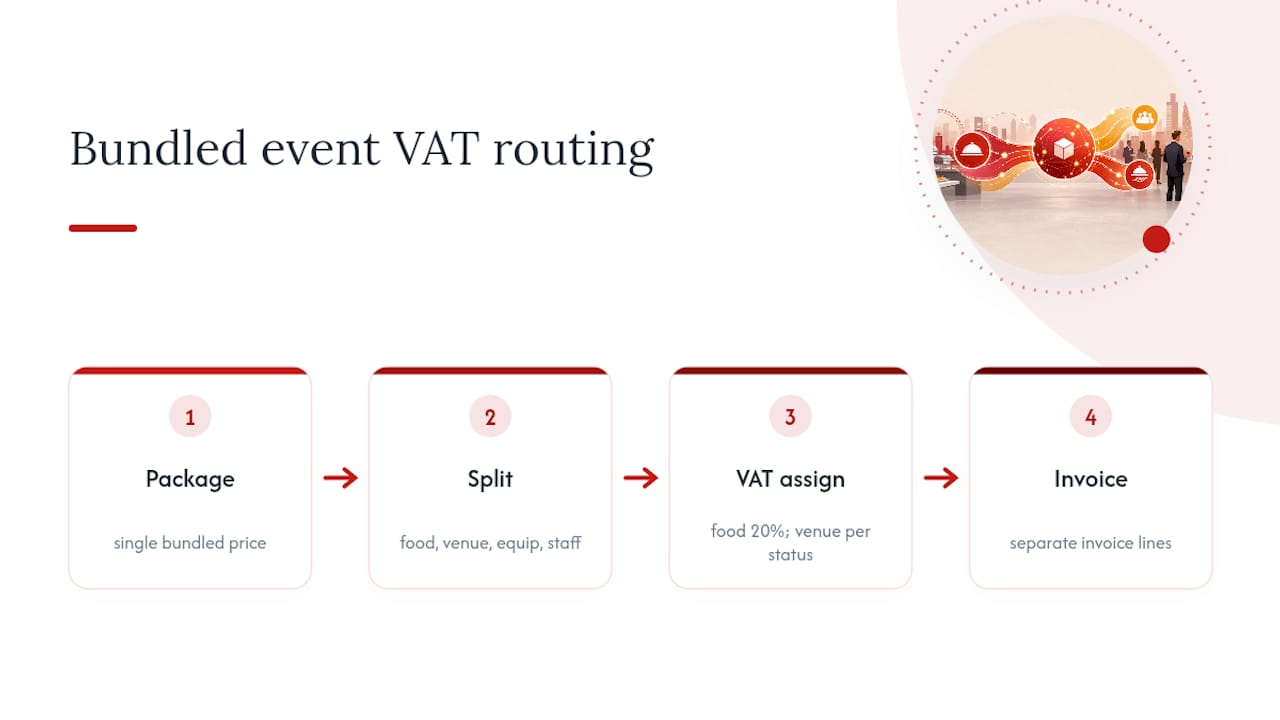
Corporate events rarely involve a single, clean supply. A package that bundles venue hire, catering, and sometimes equipment or staffing creates what HMRC treats as a mixed supply, and the VAT treatment depends on whether the elements are genuinely separate or form one combined service.
Where catering is bundled with venue hire as a single price, HMRC generally expects the caterer or event organizer to apportion VAT across the different elements based on their individual liabilities, rather than applying one blanket rate to the whole package. Food supplied as part of the package still follows catering rules, standard-rated at 20% in almost all cases, while a separately identifiable venue hire charge may carry its own VAT treatment depending on the venue’s own VAT status.
The safest approach for event contracts is itemization. Break out food, venue, and any other services as distinct line items on the invoice, each with its own VAT treatment stated clearly, rather than issuing one lump-sum figure. This protects both the supplier and the client if HMRC ever queries how the total was built. It also makes it far easier for a client’s accounts team to reconcile the invoice against their own VAT recovery position, particularly where the client can reclaim VAT on some elements of the package but not others.
VAT Invoicing Requirements Specific to Catering Businesses
A compliant VAT invoice for a catering supply needs more detail than a basic retail receipt, mostly because catering sits in a category HMRC scrutinizes more closely than straightforward grocery sales. Beyond the standard requirements, the description of goods matters enormously.
“Sandwich platter” on its own tells an inspector nothing about why the 20% rate applies. “Catering supply for corporate meeting, [date], [quantity]” ties the invoice directly to the tests HMRC uses to classify catering. The same logic applies to any order that could plausibly be read as either catering or retail: the wording on the invoice is often the first thing that gets checked when treatment is questioned.
Invoices should also separate any items taxed at different rates on the same order. Businesses using online ordering platforms should confirm the system generates itemized VAT breakdowns automatically rather than relying on manual invoice edits after the fact, since manual corrections are exactly where errors creep in.
Record-Keeping for VAT Compliance in Catering
Standard VAT recordkeeping rules apply to catering businesses the same as any other VAT-registered trader, but the nature of catering supplies makes a few records particularly important to retain. Delivery records, order confirmations, and any documentation showing the purpose of a supply all help justify the rate applied if it’s ever questioned.
For bulk supplies to other traders, contracts or purchase orders that clearly state the resale intention support any zero-rating applied on that first transaction. HMRC generally expects VAT records retained for six years, and catering businesses should keep delivery notes and dietary labeling documentation alongside standard invoices rather than treating them as separate from the VAT record.
Digital ordering systems make this considerably easier than paper trails ever did. A platform that timestamps orders, records delivery confirmations, and stores dietary and allergen labels against each order gives both the supplier and the client a clean audit trail without extra administrative work.
How VAT Rate Changes Affect Contracts and Pricing
Fixed-price catering contracts written before a VAT rate change can create real problems, particularly for businesses locked into annual corporate catering agreements. If a contract states a gross price inclusive of VAT and the applicable rate shifts mid-term, either the supplier absorbs the difference or the contract needs a clause allowing price adjustment to reflect the new rate.
Any business with existing catering contracts covering children’s meals needs pricing that clearly separates the net price from VAT, so the reduced rate can be applied and then reversed on 2 September 2026 without renegotiating the entire contract. Contracts written as VAT-exclusive prices, with VAT added at the applicable rate at the time of supply, handle rate changes far more smoothly than those quoting a single VAT-inclusive figure.
For corporate clients budgeting catering spend across a financial year, it’s worth flagging that a catering budget built on VAT-inclusive pricing should be reviewed whenever a temporary rate takes effect or lapses, since the underlying cost per order can shift even when the supplier’s net price stays the same.
Why Most Businesses Overcomplicate This
The conventional advice on catering VAT tends to focus on edge cases, hot food loopholes, bulk supply exceptions, mixed package apportionment, as if they’re the norm. They aren’t.
Where businesses actually get caught out isn’t misreading the law. It’s sloppy paperwork: vague invoice descriptions, missing delivery records, and pricing models that don’t separate VAT clearly enough to survive a rate change.
If you take one thing from this guide, make it this: build your documentation habits around HMRC’s own tests, purpose, preparation, timing, temperature, rather than around what competitors or generic guides assume catering means. The rules reward precision, not caution.
— Efe
Businesses that want catering handled by people who already build these controls into every order can see how Theofficelunch structures office catering across London and Surrey, from dietary labeling to delivery timing, before placing their next corporate lunch order.