

A catering brief for corporate events is a formal document that specifies every operational requirement your vendor needs to deliver accurate proposals and execute flawless service. Without one, you get vague quotes, mismatched menus, and billing disputes after the event. The most effective briefs cover guest count, dietary requirements, service style, budget, and timeline before a single vendor conversation begins. Corporate event planners who use a standardized brief format consistently get better proposals, faster. This guide walks you through exactly what to include, how to structure it, and when to send it.
What essential information must be in a catering brief for corporate events?
A catering brief is only as useful as the details it contains. Vague requests produce vague quotes, and vague quotes make vendor selection nearly impossible to compare fairly.
Every brief must include these core elements:
- Event basics: Event type (board meeting, all-hands, product launch), date, venue name and address, setup time, service start, and hard end time.
- Guest count: Confirmed headcount plus a realistic maximum. Flag whether the number is firm or estimated.
- Dietary requirements: List restrictions by category and headcount. For example: 12 vegetarian, 4 vegan, 3 gluten-free, 1 nut allergy. Never lump them together as “a few dietary needs.”
- Service format: Specify plated, buffet, boxed, or grazing. Each format drives different staffing, equipment, and cost structures.
- Budget: State your per-head budget or total ceiling. Vendors who cannot work within it will self-select out, saving everyone time.
- Scope of work: Clarify whether the caterer is responsible for setup, service, and cleanup, or just delivery. A clear scope of work that specifies service style, courses, dietary alternatives, and bar service produces accurate, comparable quotes.
- Equipment responsibilities: State who provides tables, linens, serving equipment, and chafing dishes. Assume nothing.
Pro Tip: Add a one-paragraph “event context” section at the top of your brief. Describe the tone of the event, the audience profile, and any brand or presentation standards. Vendors who understand the context make better menu suggestions without extra back-and-forth.
A brief that answers all of these questions up front cuts the proposal revision cycle from weeks to days. Corporate caterers are built around repetitive, time-sensitive delivery rather than bespoke social events, so the more operational detail you provide, the more accurate their execution will be.
How to structure and standardize your catering brief
Standardizing your brief format is one of the highest-return habits a corporate event planner can build. Standardizing the brief format saves approximately 4 days of communication and lets you compare proposals in a single 15-minute spreadsheet review. That time compounds across every event you run in a year.
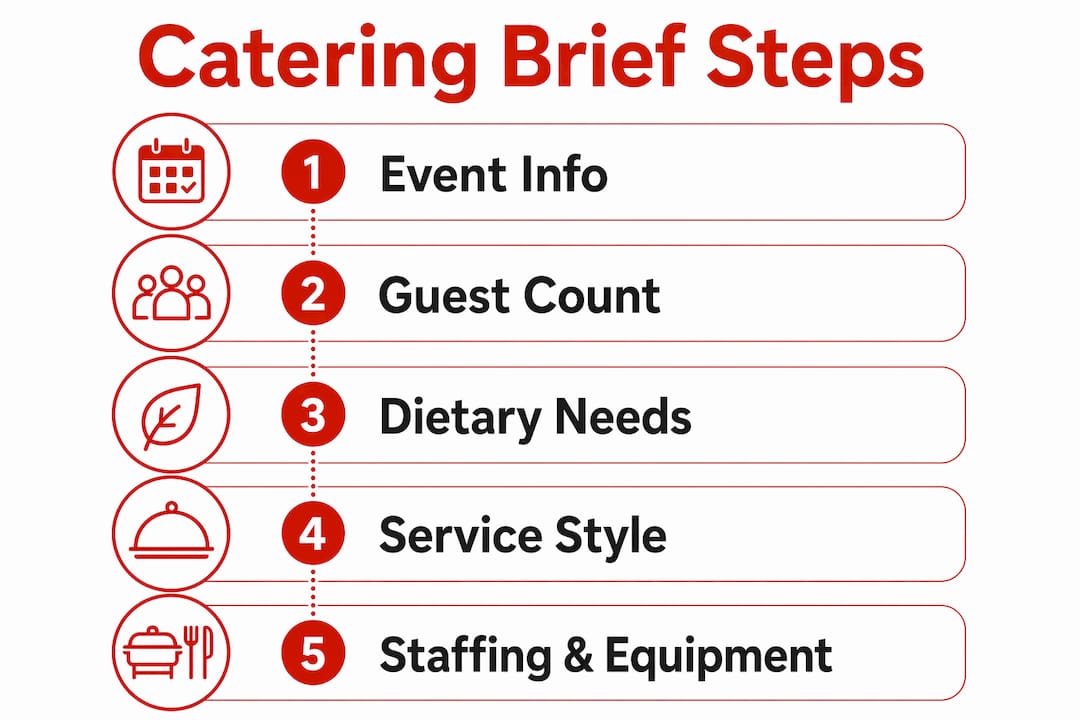
A well-structured brief follows this order:
- Event overview: One paragraph covering event type, date, venue, and expected atmosphere.
- Guest count and demographics: Confirmed headcount, expected range, and any audience notes (executives, external clients, mixed dietary profiles).
- Dietary and allergen requirements: Itemized by restriction type and headcount.
- Service style and timeline: Format, setup window, service start, and end time.
- Scope of work: What the caterer is responsible for, from delivery through cleanup.
- Budget parameters: Per-head target or total ceiling, with any flexibility noted.
- Submission deadline: The date by which you need proposals returned.
Use consistent language across every brief you send. If you call it “service start time” in one document, do not call it “meal time” in the next. Inconsistency forces vendors to ask clarifying questions, which defeats the purpose of a standardized document.
| Brief section | What to specify |
|---|---|
| Event overview | Type, date, venue, tone |
| Guest count | Confirmed number, maximum, and flexibility |
| Dietary requirements | Restriction type and headcount per category |
| Service style | Plated, buffet, boxed, or grazing |
| Scope of work | Setup, service, cleanup responsibilities |
| Budget | Per-head or total ceiling |

Pricing transparency is another area where structure pays off. Escalation clauses tied to recognized cost indices, such as the Consumer Price Index for Food Away From Home, protect both you and the vendor in long-term or recurring contracts. Include a clause in your brief that asks vendors to flag any index-linked pricing adjustments in their proposals.
Pro Tip: Create a master brief template in a shared document. Fill in the fixed fields once, then update only the event-specific fields for each new booking. You will send cleaner briefs and spend less time on admin.
What are best practices for communicating dietary and safety requirements?
Dietary and safety requirements are the section of a catering brief where vagueness causes the most damage. A missed allergen is not a minor inconvenience. It is a health risk and a liability.
Follow these practices to communicate requirements clearly:
- Itemize by headcount. Write “8 vegetarian, 3 vegan, 2 gluten-free” rather than “some guests have dietary needs.” Vendors cannot plan portions or alternatives without numbers.
- Flag major allergens explicitly. The UK Food Standards Agency recognizes 14 major allergens, including nuts, gluten, dairy, eggs, and shellfish. List every relevant allergen by name, not by category.
- Set temperature standards. Hot food must be held above 140°F throughout service. Include this as a non-negotiable requirement in your brief, not as a verbal reminder on the day.
- Define must-have criteria. Separate “required” from “preferred.” A nut-free environment for a guest with a severe allergy is a requirement. A preference for organic ingredients is not.
- Lock requirements early. Setting dietary must-haves at T-24 hours or earlier prevents service gaps. Late changes after the vendor has prepped create real operational problems.
Dietary requirements should be treated as operational specifications, not preferences. A brief that lists restrictions by headcount and flags allergens by name gives vendors the same level of detail they need to execute safely as a kitchen order ticket. Ambiguity at the briefing stage becomes a service failure at the event.
For corporate events with complex dietary profiles, consider asking vendors to submit a sample allergen matrix with their proposal. This confirms they have the systems to track and separate dietary alternatives during service, not just the intention to do so.
How to specify service style, staffing, and equipment clearly
Service style determines everything downstream: staffing ratios, equipment needs, setup time, and cost. Specifying it precisely in your brief prevents the most common source of proposal mismatch.
| Service style | Best suited for | Key brief requirements |
|---|---|---|
| Plated | Formal dinners, board events | Staffing ratio, course count, timing per course |
| Buffet | All-hands, team lunches | Queue management, replenishment schedule |
| Boxed meals | Seminars, training days | Individual labeling, dietary coding per box |
| Grazing | Networking, receptions | Setup duration, replenishment frequency |
Staffing ratios belong in every brief. The standard ratio for plated service is 1 server per 15–20 guests. For buffet service, the ratio shifts because guests serve themselves, but you still need staff for replenishment, clearing, and allergen management. State your expectations explicitly rather than leaving it to the vendor’s default.
For training days and half-day seminars, bite-sized or portion-controlled options maintain attendee engagement better than heavy plated meals. Individual boxes prevent the post-lunch energy drop that derails afternoon sessions. Include this preference in your brief’s service style section, not as a last-minute verbal request.
Pro Tip: For multi-session events, specify catering timing per session block in your brief. A morning tea break, a working lunch, and an afternoon refresh each have different lead times and service requirements. Bundling them into one line item produces inaccurate quotes.
Equipment responsibilities are a frequent source of dispute. Your brief should state clearly who provides serving platters, chafing dishes, linens, and waste disposal. For Fortune 500 corporate event setups, equipment coordination across multiple vendors requires written confirmation in every brief, not verbal agreements.
When and how to send your catering brief for best results
Timing your brief submission correctly is as important as the content inside it. Sending too late limits your vendor options and reduces proposal quality.
- Standard internal corporate events: Send your brief at least 3–4 months in advance. This gives vendors time to confirm availability, source ingredients, and staff appropriately.
- Hotel or multi-vendor productions: Submit 6 months ahead. These events involve coordination across catering, AV, decor, and venue operations teams, and each dependency adds lead time.
- Q4 events: Add an extra buffer. October through december is peak season for corporate events, and premium venues and vendors book early. A brief sent in september for a november event is not early. It is on time.
- Headcount lock: Confirm your final headcount at T-72 hours before the event. Locking headcount at T-72 hours with a defined tolerance protects you from last-minute billing disputes while giving vendors enough time to adjust.
- Follow-up confirmation: Send a written confirmation 48 hours before the event that restates service time, headcount, dietary requirements, and access instructions. Do not assume the vendor’s file matches your latest version.
For events with multiple catering vendors, assign one point of contact on your team to own all vendor communication. Fragmented communication across multiple planners produces conflicting instructions and service failures.
Key Takeaways
A catering brief for corporate events works best when it specifies guest count, dietary requirements, service style, budget, and timeline in a single standardized document sent well before the event date.
| Point | Details |
|---|---|
| Include all core details upfront | Specify event type, headcount, dietary needs, service style, budget, and scope before sending. |
| Standardize your brief format | A consistent template saves days of back-and-forth and makes proposal comparison straightforward. |
| Itemize dietary requirements by headcount | List each restriction type with a number attached to get accurate, safe catering proposals. |
| Lock headcount at T-72 hours | Confirming final numbers 72 hours out prevents billing disputes and last-minute service gaps. |
| Send briefs 3–6 months in advance | Standard events need 3–4 months; hotel or multi-vendor productions need at least 6 months. |
What I’ve learned from watching planners get this wrong
After years of watching corporate events run smoothly and fall apart, the pattern is consistent. Events that go wrong almost always trace back to a brief that was either too vague or sent too late. The planner assumed the vendor would “figure it out.” The vendor assumed the planner would “follow up.” Nobody confirmed the dietary breakdown in writing. The gluten-free guest got a regular sandwich.
The uncomfortable truth is that most catering failures are documentation failures. The food was fine. The vendor was capable. The brief just did not give them what they needed to execute correctly.
The planners I respect most treat their catering brief the same way a project manager treats a scope document. Every assumption gets written down. Every requirement gets a number attached. Every deadline gets confirmed in writing. They do not rely on “we discussed this on the call” as a safety net.
One habit that separates good planners from great ones: they send the same brief format every time, even for small internal lunches. Consistency builds vendor relationships faster than any other practice. When a vendor knows exactly what to expect from your documents, they prioritize your events because working with you is efficient. That is a real competitive advantage when you are trying to book a quality vendor for a Q4 event.
If you are starting from scratch, build your template around the sections in this article, test it on your next two events, and refine from there. The brief that takes you 30 minutes to fill out will save you 4 days of email chains and one very awkward post-event debrief.
— Efe
Theofficelunch makes corporate catering easier to plan
Corporate event planners in London and Surrey trust Theofficelunch for reliable, time-sensitive catering that fits the pace of business. Since 2015, Theofficelunch has delivered fresh sandwich platters and tailored meal options to offices, meetings, and events across the region, covering dietary needs without adding administrative overhead.

Whether you are planning a weekly team lunch or a full-day seminar, Theofficelunch handles office catering in London with menus built around real dietary variety and punctual delivery. The ordering process is direct and the menu options are clear, so you spend less time coordinating and more time running your event. Explore the full range of corporate lunch delivery options and get a quote that matches your brief.
FAQ
What is a catering brief for corporate events?
A catering brief is a document that outlines every operational requirement for event catering, including guest count, dietary needs, service style, budget, and timeline. It gives vendors the information they need to submit accurate proposals.
How far in advance should I send a catering brief?
Send your brief at least 3–4 months before standard internal events and 6 months before hotel or multi-vendor productions. Q4 events require even earlier submission due to high vendor demand.
What dietary information should I include in a catering brief?
List every dietary restriction by type and headcount, for example “5 vegan, 3 gluten-free, 1 nut allergy.” Flag major allergens by name and specify any must-have requirements separately from preferences.
When should I lock in the final headcount?
Lock your final headcount at T-72 hours before the event. This gives vendors time to adjust while protecting you from last-minute billing disputes caused by significant count changes.
What service styles should I specify in a catering brief?
Specify whether you need plated, buffet, boxed, or grazing service, and include the staffing ratio you expect. For training days, portion-controlled or boxed options maintain attendee energy better than heavy buffet formats.
Recommended
- How to Choose Catering for Company Gatherings – Sandwich platters – Office Lunch – Catering company-Party food
- How Catering Supports Business Celebrations That Work – Sandwich platters – Office Lunch – Catering company-Party food
- Office catering London – Sandwich platters – Office Lunch – Catering company-Party food
- Corporate lunch delivery London – Sandwich platters – Office Lunch – Catering company-Party food