

A company catering budget is a structured allocation of funds across event types, headcount, and service expectations to control costs and maintain quality. To set a catering budget for business events effectively, you start by segmenting events into tiers, estimating per-person costs with all fees included, and reserving a 10–15% contingency fund for price increases or attendance changes. Best practice places catering at 20–30% of the total event budget. That range gives you a defensible number to present to finance while leaving room to adjust for the unexpected. This guide walks you through every step: categorizing events, calculating real costs, securing approval, and tracking spend across the year.
How to set a catering budget for business events by event type
Catering budgets fail when planners treat every event the same. Segmenting your budget by occasion type from the start ensures spend aligns with the expectations each event carries. A working lunch has different food, presentation, and service requirements than a client dinner or a company-wide celebration.
The three core categories most corporate planners use are:
- Working lunches and team meetings. These are frequent, low-ceremony events. The goal is reliable, filling food delivered on time. Presentation matters less than consistency and dietary coverage.
- All-hands meetings and team celebrations. These events carry higher morale stakes. Attendees notice the quality and variety. Budget more per person and plan for a wider menu.
- Client-facing and executive events. These require the highest per-person spend. Food quality, presentation, and service reflect directly on your company’s brand. Cutting corners here costs more in reputation than it saves in catering fees.
For each category, track two numbers: anticipated frequency per year and expected headcount. A company running 40 working lunches per year at 15 people each has a very different annual catering commitment than one running 4 client dinners at 20 people. Knowing both figures lets you build a realistic annual catering plan rather than reacting event by event.
Pro Tip: Create a simple three-tier label system (Tier 1 for internal, Tier 2 for company-wide, Tier 3 for client-facing) and assign a per-person range to each. When a new event request comes in, you assign a tier and the budget almost writes itself.

Understanding what corporate catering involves across these tiers also helps you communicate expectations clearly to vendors and internal stakeholders before any order is placed.
How do you estimate per-person catering costs accurately?
Per-person cost estimation is the technical core of any catering budget. The number most planners quote is food cost only. The real number includes food, beverages, service fees, delivery charges, and setup or breakdown costs. Service and delivery fees typically add 10–20% on top of food costs, so a £20 per-person food quote becomes £22–£24 all-in.
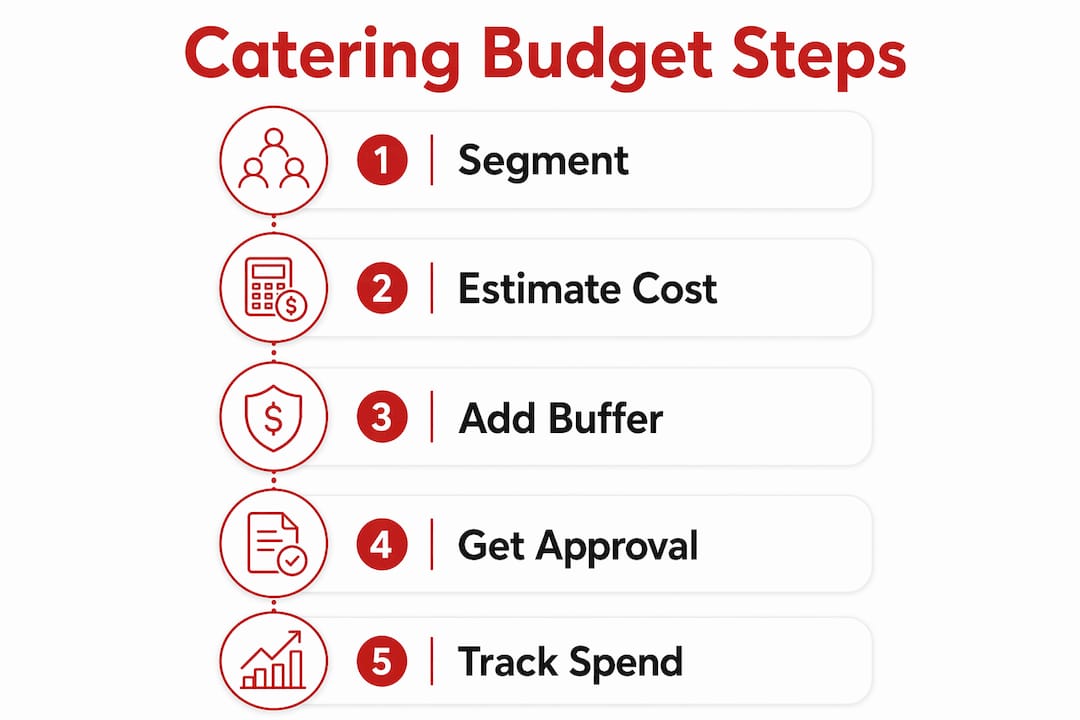
The table below gives realistic all-in ranges by event type for London and Surrey markets in 2026:
| Event type | Food cost per person | All-in estimate (with fees) |
|---|---|---|
| Working lunch | £15–£22 | £17–£26 |
| Company-wide event | £20–£30 | £22–£36 |
| Client-facing or executive meal | £30+ | £33–£45+ |
These ranges reflect base catering only. Alcohol, specialist dietary menus, or premium service styles push costs higher. Build your estimate from the bottom up: confirm the food cost, add the service and delivery fees, then apply your buffer.
The buffer matters more than most planners expect. Ordering with a 10–15% buffer on each order accounts for last-minute attendance changes and dietary requirements. Reordering on event day costs more and causes disruption. A moderate over-order upfront is almost always the cheaper option.
Accurate food quantity planning also depends on service style. A buffet requires more food per person than a plated lunch because guests self-serve and portions vary. Factor service style into your per-person estimate before you finalize any number.
Pro Tip: Call your caterer before you finalize the budget, not after. Ask them directly: “What is the realistic all-in cost for this event type at this headcount?” A good caterer will give you a number that includes fees and flag any variables that could push costs up.
How do you get your catering budget approved by finance?
Finance rejects lump-sum catering requests. Line-item budgets that separate food costs, service fees, delivery, and contingency get approved because they show control and transparency. The structure signals that you have thought through the spend, not just guessed a total.
A strong catering budget submission to finance includes these elements:
- Event breakdown by type. List each event category, expected frequency, and average headcount. Finance needs to see how many events are driving the total number.
- Per-person cost by tier. Show the all-in per-person estimate for each event type, including fees. This makes the math auditable.
- Annual food and beverage total. Multiply per-person cost by headcount by frequency for each tier. Sum the tiers for the annual total.
- Service and delivery fees. Call these out as a separate line. Burying them in food costs looks like padding.
- Contingency reserve. State the percentage (10–15%) and explain what it covers: price increases, headcount changes, and last-minute dietary needs.
- Prior year comparison. If you have actual spend data from previous events, include it. Showing that your estimate is grounded in real history builds credibility fast.
Tying catering spend to business outcomes also strengthens the case. A client lunch that supports a contract renewal is not a cost center. A team celebration that reduces turnover pays back more than the catering invoice. Frame the spend in those terms when the event type warrants it.
Pro Tip: Present an annual catering plan to your preferred vendors before the year starts. Annual contracts often include volume discounts, fixed pricing, and complimentary upgrades. That plan also gives finance a full-year view, which makes individual event approvals faster and less contentious.
Best practices for tracking and adjusting your catering spend
Tracking actual versus estimated spend is the only way to improve your catering budget over time. A simple log with four columns covers everything you need: event type, estimated cost, actual cost, and headcount. Run it in a spreadsheet and update it within 48 hours of each event while the details are fresh.
Tracking actual versus estimated spend reveals patterns that are invisible without data. You may find that client-facing events consistently run 15% over estimate because your per-person assumption is too low. Or that working lunches regularly come in under budget because attendance is lower than planned. Both findings let you recalibrate your tiers before the next budget cycle.
Avoid these common pitfalls in budget monitoring:
- Skipping the post-event review. The log only works if you fill it in. Schedule a 10-minute review after every catered event.
- Tracking food cost only. Always record the all-in invoice total, including fees, so your data matches what you actually spent.
- Ignoring headcount variance. If 20 people were expected and 14 attended, note that. It tells you whether your headcount estimates are consistently off.
- Waiting until year-end to analyze. Quarterly reviews let you adjust tier budgets mid-year before overspending compounds.
- Failing to share findings with your caterer. A good catering partner uses your spend data to refine menus and portion sizes for future events.
Regular communication with your caterer also helps you choose catering for company gatherings that genuinely fits the event rather than defaulting to the same menu every time. Over a full year, that kind of ongoing dialogue produces better food, fewer surprises, and tighter cost control.
Key Takeaways
Setting a catering budget for business events requires segmenting events by type, building all-in per-person estimates with buffers, and presenting line-item breakdowns to secure finance approval.
| Point | Details |
|---|---|
| Segment events into tiers | Assign working lunches, company-wide events, and client meals to separate budget tiers with distinct per-person ranges. |
| Include all fees in estimates | Add service and delivery fees (10–20% of food cost) to every per-person estimate before finalizing any budget. |
| Reserve a contingency fund | Set aside 10–15% of the catering budget to cover headcount changes, price increases, and last-minute dietary needs. |
| Use line-item budgets for approval | Separate food, service, delivery, and contingency into distinct lines to give finance the transparency needed to approve. |
| Track actual versus estimated spend | Maintain a simple log after every event and review quarterly to recalibrate tier budgets and improve future accuracy. |
What I’ve learned from years of corporate catering budgets
The most common mistake I see is planners building a catering budget after the event calendar is already set. By that point, the headcount is locked, the venue is booked, and the only variable left is how much you spend per person. That is the worst time to negotiate. The planners who get the best results start with the budget framework in january, before any event is confirmed.
Annual planning also changes the vendor relationship entirely. When you bring a caterer a full-year plan with projected headcounts and event types, you are no longer a one-off customer. You become a volume account. That shift unlocks pricing conversations that are simply not available when you order event by event. I have seen teams reduce their per-event catering cost meaningfully just by consolidating orders with one vendor and committing to an annual volume.
Transparency with finance is underrated. Most budget rejections I have witnessed came from planners who submitted a single total with no breakdown. Finance is not trying to cut your catering budget. They are trying to understand it. A clear line-item submission with a contingency explanation almost always gets approved faster than a round number with no context.
The contingency reserve also reduces stress in a way that is hard to quantify. Knowing you have a 10–15% buffer means that when 5 extra people show up or a dietary requirement surfaces at the last minute, you handle it without a crisis. That calm execution is what makes business celebrations work and what gets catering budgets approved again next year.
— Efe
Theofficelunch makes corporate catering budgets easier to manage
Corporate event planners in London and Surrey use Theofficelunch for fresh sandwich platters and flexible meal options that fit every event tier, from quick working lunches to client-facing spreads. Transparent pricing makes it straightforward to build accurate per-person estimates before you submit a budget for approval.

Theofficelunch has served corporate clients since 2015, with reliable delivery, clear menu options covering dietary needs, and ordering that keeps administrative overhead low. Whether you are planning a single team lunch or building an annual catering program across multiple event types, Theofficelunch gives you the pricing clarity and service consistency that make budget management far less complicated.
FAQ
What percentage of an event budget should go to catering?
Best practice allocates 20–30% of the total event budget to catering and beverages. A 10–15% contingency reserve on top of that covers price increases and headcount changes.
What is a realistic per-person catering cost for a working lunch?
Working lunches typically cost £15–£22 per person for food, with service and delivery fees adding 10–20% to reach an all-in estimate of £17–£26 per person.
Why do catering budgets get rejected by finance?
Finance rejects lump-sum catering requests that lack a breakdown. Line-item budgets separating food, service fees, delivery, and contingency get approved because they demonstrate cost control and transparency.
How do I build a contingency into my catering budget?
Add a 10–15% reserve to each catering order to cover last-minute attendance changes and dietary requirements. Reordering on event day costs more than moderate over-ordering upfront.
How does annual catering planning help with budget control?
Presenting an annual catering plan to vendors unlocks volume discounts, fixed pricing, and complimentary upgrades. It also gives finance a full-year view that speeds up individual event approvals throughout the year.
Recommended
- How Catering Supports Business Celebrations That Work – Sandwich platters – Office Lunch – Catering company-Party food
- How to Choose Catering for Company Gatherings – Sandwich platters – Office Lunch – Catering company-Party food
- Office breakfast catering London – Sandwich platters – Office Lunch – Catering company-Party food
- Office catering London – Sandwich platters – Office Lunch – Catering company-Party food