

A recurring catering arrangement is a scheduled, ongoing meal delivery service that supplies organizations with consistent food on a fixed timetable, whether daily, weekly, or monthly. Unlike one-off event catering, this model turns ad-hoc food ordering into a standing order system with predictable delivery windows and pre-agreed menus. The industry term you will hear most often is a catering subscription model or standing catering contract, though “recurring catering arrangement” describes the same structure. For organizations running regular meetings, training days, or team lunches, this approach removes the guesswork from food logistics and replaces it with a reliable, repeatable process.
What is a recurring catering arrangement and how does it work?
A recurring catering arrangement converts meal ordering from a reactive task into a planned system. The caterer and client agree on a delivery schedule, a base menu, headcount estimates, and a billing cycle before the first order ships. From that point, food arrives on the agreed days without the client needing to reorder each time.
Scheduling frequency is the first decision organizations make. Options typically include daily, twice weekly, three times weekly, or monthly delivery. Daily recurring catering demands significantly more operational effort than a twice or three-times-weekly model. Starting at a lower frequency lets both the caterer and the client test demand and iron out logistics before scaling up.
Menu planning runs alongside scheduling. The most effective programs use a 4-week rotating menu to prevent meal fatigue and keep employees engaged over the long term. Each week within the cycle offers different options, and the cycle repeats monthly. This approach also simplifies procurement for the caterer, since ingredient lists stay predictable.

Dietary accommodations sit at the center of any well-run program. Clients submit dietary profiles covering allergies, vegetarian, vegan, gluten-free, and other requirements. The caterer labels each item clearly and adjusts quantities as headcount changes. Dietary management is the most operationally demanding part of recurring catering, but it also builds the deepest client trust when handled well.
Billing follows a subscription-style cycle. Most programs invoice weekly or monthly, with headcount adjustments submitted a set number of days before each delivery. Recurring catering services typically include flexible invoicing and easy headcount adjustments between orders, which removes the friction of renegotiating terms every time attendance changes.
Pro Tip: Set your headcount adjustment deadline at least 48 hours before each delivery. This gives your caterer enough time to source accurate quantities and reduces waste on both sides.
What are the benefits of adopting a recurring catering service?
Recurring catering delivers measurable advantages that one-off orders cannot replicate. The core benefit is predictability. Both the client and the caterer know exactly what is coming, when it arrives, and what it costs. That predictability reduces logistical chaos and frees up administrative time that would otherwise go toward sourcing, comparing quotes, and chasing deliveries.
The operational benefits stack up quickly:
- Simplified ordering. One setup conversation replaces dozens of individual orders across the year.
- Reduced downtime. Meals arrive on schedule, so employees do not leave the office to find food during working hours.
- Consistent quality. A standing relationship with one caterer means quality standards are agreed upfront and maintained across every delivery.
- Dietary reliability. Profiles are set once and updated as needed, rather than re-explained with every new order.
- Supplier trust. Long-term relationships give organizations more influence over menu choices, pricing, and service adjustments.
Cost savings are a direct result of volume and commitment. Caterers offer better per-head pricing to clients who commit to regular orders because predictable demand lowers their own procurement and staffing costs. Those savings pass through to the client in the form of negotiated rates that ad-hoc orders rarely achieve.
Employee morale is a less obvious but well-documented benefit. Providing consistent, quality meals signals that an organization values its people’s time and wellbeing. Teams that eat well at work report higher satisfaction and are less likely to spend long lunch breaks away from the office. For organizations running back-to-back meetings, a weekly catering service keeps energy levels steady without disrupting the day’s schedule.
What are common pricing models and cost factors in recurring catering?
Pricing in recurring catering follows a tiered structure based on menu complexity, service level, and delivery frequency. Understanding the tiers helps organizations match their budget to the right program from the start.
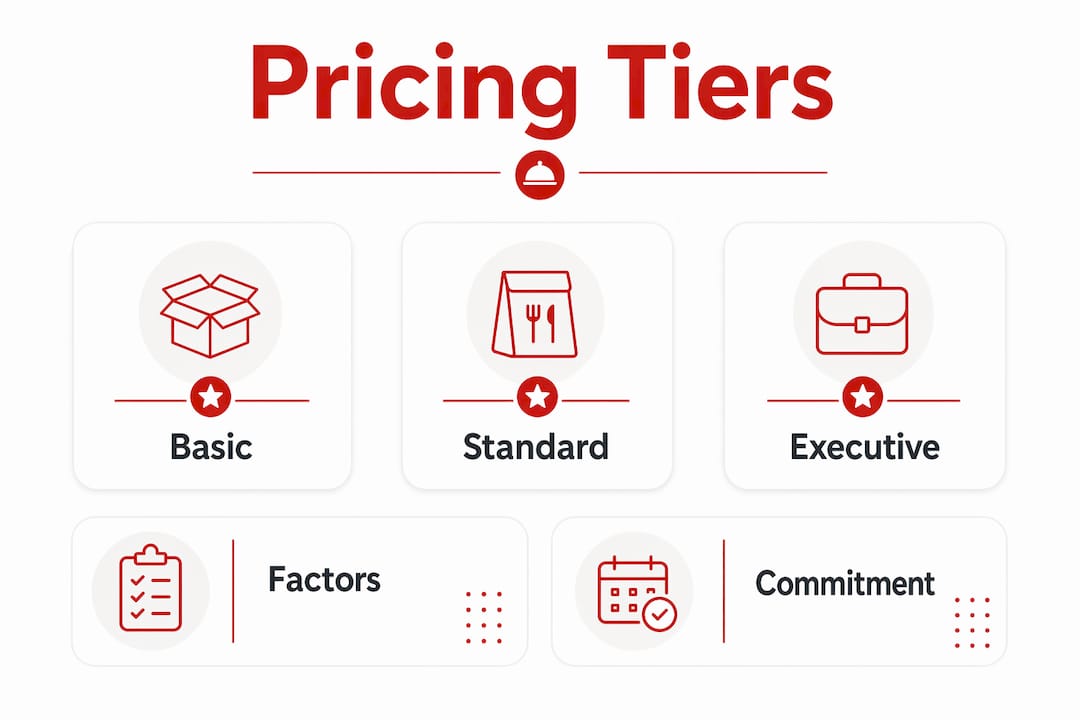
| Service tier | Typical cost per head | What’s included |
|---|---|---|
| Basic | £8–£12 | Sandwich platters, simple sides, standard packaging |
| Mid-range | £14–£20 | Hot or cold mixed menus, dietary options, labeled items |
| Executive | £25–£35 | Premium ingredients, full dietary management, presentation service |
Standard recurring catering pricing ranges from £8–£12 per head for basic meals to £25–£35 per head for executive-level services. That spread reflects the difference between a simple sandwich platter and a fully managed, multi-option lunch program with allergy labeling and presentation. In the U.S. market, many programs start at $14.50 per person for individually packaged lunches or family-style office meal plans.
Several factors push costs up or down within each tier. Menu complexity is the biggest driver. A rotating menu with hot options, multiple dietary tracks, and branded packaging costs more to produce than a fixed cold platter. Delivery frequency also affects unit cost. Daily delivery spreads fixed logistics costs across more orders, which can lower the per-head rate at scale. Dietary accommodations add cost when they require separate preparation lines or specialist ingredients.
Contract commitment versus flexible plans is another pricing variable. Clients who sign a fixed-term catering contract, typically three or six months, usually receive a lower per-head rate than those on a rolling monthly plan. The trade-off is reduced flexibility to cancel or reduce orders without a penalty.
Billing automation matters more than most organizations realize. Over 75% of customers on auto-pay significantly reduces invoice processing friction and payment delays. Setting up auto-pay from the start protects the caterer’s cash flow and removes a recurring administrative task from the client’s plate.
Pro Tip: Ask your caterer for a per-head rate breakdown that separates food cost from delivery and service fees. This makes it easier to compare quotes accurately and identify where you can adjust scope to fit your budget.
How to choose the right recurring catering arrangement for your organization
Selecting the right program requires honest answers to a few key questions before you contact any caterer. Organizations that skip this step often end up locked into a service level that does not match their actual needs.
-
Assess your meal frequency. Count how many days per week your organization genuinely needs catering. A team that meets formally twice a week does not need a daily program. Starting with lower frequency is the standard advice from experienced caterers, because it lets you test kitchen capacity and actual demand before committing to more.
-
Map your dietary profile. Survey your team before you approach a caterer. Know the number of vegetarians, vegans, gluten-free eaters, and anyone with a serious allergy. This data lets you evaluate whether a caterer can genuinely serve your group, not just claim they can.
-
Evaluate menu variety and rotation. Ask any shortlisted caterer how they handle menu rotation for engagement. A 4-week rotating cycle is the recognized standard. Caterers who offer only a fixed menu will create fatigue within weeks. You can also review seasonal menu ideas from sources like festive meal planning guides to understand what variety looks like in practice.
-
Set a realistic budget per head. Use the pricing tiers above as a benchmark. Decide whether your priority is cost control or menu quality, and be transparent with your caterer. Most programs can be adjusted to fit a budget if the conversation happens early.
-
Negotiate a trial period. Request a four to six week trial before signing any long-term catering contract. A trial period lets you evaluate delivery punctuality, food quality, dietary accuracy, and communication before committing to a full program. A caterer confident in their service will agree to this without hesitation.
For a detailed framework on evaluating catering options before you commit, review the key criteria that separate reliable providers from those who overpromise.
Key Takeaways
A recurring catering arrangement delivers the most value when organizations match their delivery frequency, dietary needs, and budget to a clearly structured catering subscription model before signing any contract.
| Point | Details |
|---|---|
| Start with lower frequency | Test demand with twice-weekly delivery before committing to a daily program. |
| Use a 4-week rotating menu | Rotating menus prevent meal fatigue and sustain long-term employee engagement. |
| Set auto-pay from day one | Auto-pay adoption above 75% reduces invoice friction and administrative overhead. |
| Map dietary needs upfront | Submitting accurate dietary profiles before launch prevents errors and builds trust. |
| Negotiate a trial period | A four to six week trial lets you verify quality and reliability before a long-term contract. |
What I have learned from watching recurring catering programs succeed and fail
After watching dozens of organizations set up recurring catering programs, the pattern that separates the ones that last from the ones that quietly collapse is almost always the same. Teams that treat the setup conversation as a formality end up frustrated within two months. Teams that treat it as a proper operational brief get consistent results for years.
The single most underrated step is the dietary audit. Organizations routinely underestimate how many people have dietary requirements until the first delivery arrives and three people cannot eat anything on the table. Doing a proper headcount survey before you brief any caterer is not optional. It is the foundation the entire program sits on.
Menu rotation is the second thing organizations get wrong. A fixed menu feels like a safe choice because it is simple to manage. In practice, employees stop looking forward to lunch within three weeks. A rotating menu schedule is not a luxury feature. It is what keeps the program alive past the first quarter.
The billing setup matters more than people expect. Organizations that leave invoicing on a manual approval cycle end up with delayed payments, strained supplier relationships, and, eventually, reduced service priority. Auto-pay is not just convenient. It signals to your caterer that you are a reliable client, and reliable clients get better service.
My honest advice: start smaller than you think you need, get the dietary brief right, and automate the payment. Everything else is adjustable.
— Efe
How Theofficelunch supports your recurring catering needs
Theofficelunch has been delivering fresh, professionally prepared meals to London and Surrey offices since 2015. The service is built around the exact structure described in this article: fixed delivery schedules, rotating menus, full dietary accommodation, and billing that does not create extra work for your team.

Whether your organization needs a twice-weekly sandwich platter program or a fully managed daily lunch service, Theofficelunch adapts the format to your headcount and budget. Every order covers dietary labeling, correct delivery temperatures, and on-time arrival. For organizations ready to move from ad-hoc ordering to a reliable recurring model, office catering in London through Theofficelunch is a practical starting point. You can also review the 2026 corporate catering brief guide to prepare your requirements before your first conversation.
FAQ
What is a recurring catering arrangement?
A recurring catering arrangement is a scheduled, ongoing food delivery service where a caterer supplies meals to an organization on a fixed timetable, such as weekly or daily, under a pre-agreed menu and billing structure. It replaces one-off orders with a standing system that improves predictability for both client and caterer.
How does a catering subscription model differ from a catering contract?
A catering subscription model typically runs on a rolling basis with flexible headcount adjustments and no long-term commitment, while a catering contract locks in terms for a fixed period, usually three to six months, often at a lower per-head rate in exchange for that commitment.
What does recurring catering typically cost per person?
Pricing ranges from £8–£12 per head for basic meal programs to £25–£35 per head for executive-level services, with U.S. programs often starting at $14.50 per person for individually packaged lunches.
How often should a recurring food delivery program rotate its menu?
A 4-week rotating menu is the recognized standard for preventing meal fatigue and maintaining employee engagement in long-term recurring catering programs.
What should organizations check before signing a recurring catering agreement?
Organizations should verify the caterer’s dietary management capability, request a menu rotation schedule, confirm flexible invoicing terms, and negotiate a four to six week trial period before committing to a full catering contract.
Recommended
- Catering Brief for Corporate Events: 2026 Guide – Sandwich platters – Office Lunch – Catering company-Party food
- Catering Checklist Guide for Event Planners in 2026 – Sandwich platters – Office Lunch – Catering company-Party food
- How Catering Supports Business Celebrations That Work – Sandwich platters – Office Lunch – Catering company-Party food
- Corporate Event Catering Timeline Guide for Planners – Sandwich platters – Office Lunch – Catering company-Party food