

Platter catering is defined as a shared food service format where prepared items are arranged on serving trays and placed for guests to help themselves, rather than receiving individual plated meals. The role of platter catering in events goes well beyond convenience. It shapes how guests interact, how food holds up across flexible schedules, and how organizers manage waste and dietary variety. Professional platter services can accommodate groups from 10 to over 500 guests, with small platters serving 10–12 people and specialty platters covering 20–25. That range makes platters one of the most adaptable event catering options available.
How does platter catering improve guest experience at events?
Platter catering creates a social atmosphere that plated meals simply cannot replicate. When food is placed across a room rather than delivered to fixed seats, guests move, gather, and talk. That movement is not accidental. Platters are primary tools for encouraging social interaction at events where connection matters as much as the food itself.

Variety is the other major advantage. A well-built platter spread includes sandwiches, hors d’oeuvres, deli items, and patisserie, giving guests real choices. Curated platter spreads reflect greater hospitality and care than a boxed meal ever could. The visual presentation signals effort, and guests notice.
Inclusivity is a quiet but significant benefit. Platters allow labeled dietary options, such as vegan, gluten-free, and nut-free selections, to sit alongside standard choices without drawing attention to any individual guest’s needs. Labeled dietary options on platters let everyone eat comfortably without the awkwardness of special requests. That kind of thoughtful inclusion builds goodwill with every guest.
Key benefits for guest experience include:
- Encourages mingling by placing food at multiple points around the venue
- Offers genuine variety across dietary preferences without separate ordering
- Signals hospitality through visual presentation and food quality
- Removes the formality barrier that plated meals often create at casual or semi-formal events
Pro Tip: Label every platter clearly with its dietary profile. Guests with restrictions will feel included rather than singled out, and you will field far fewer questions during the event.
Why platter catering handles timing and scheduling better than alternatives
Event schedules rarely run perfectly. Meetings overrun, guests arrive at different times, and lunch hours shift. Platter catering is built for exactly that reality. Platter foods maintain freshness for several hours, making them ideal when meetings run 30–60 minutes over schedule or when arrivals are staggered across a window of time.
Plated meals, by contrast, are time-sensitive. A plated dish served 45 minutes late is a cold, unappetizing problem. A platter of fresh sandwiches and salads holds its quality and presentation far longer. That resilience is not a minor detail. It is the reason platter service dominates working lunches, all-day conferences, and networking events where no fixed mealtime exists.
Here is how platter catering handles the most common timing challenges:
- Staggered arrivals: Guests serve themselves when they arrive, so no one waits and no food is wasted on empty seats.
- Extended events: Platters can be refreshed or supplemented without disrupting the program, unlike plated courses that require full service resets.
- Overrunning sessions: Food stays presentable and safe for hours, removing the pressure to pause a meeting for a meal break.
- Variable appetites: Guests take what they want, reducing the risk of over-ordering for individuals who eat lightly.
The flexibility of platter service is not just convenient. It removes a genuine logistical burden from the event organizer’s plate.
Platter catering vs. other catering styles: when each one wins
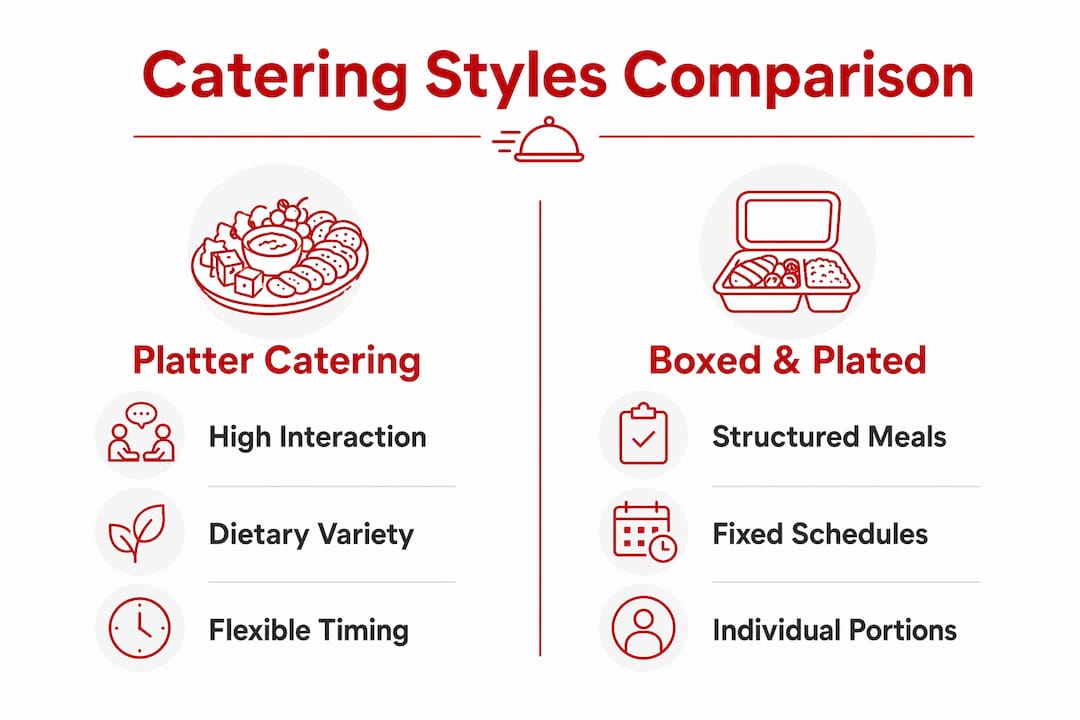
Choosing between platter catering, boxed meals, and plated service comes down to one question: what is the social energy of your event? Choosing platters or plated service depends on the event’s social energy and interaction goals. A networking lunch calls for platters. A formal awards dinner calls for plated service. A training day with back-to-back sessions calls for boxed meals.
The table below compares the three main catering styles across the factors that matter most to event organizers.
| Factor | Platter catering | Boxed meals | Plated service |
|---|---|---|---|
| Guest interaction | High. Encourages movement and conversation. | Low. Guests stay seated. | Low. Fixed seating throughout. |
| Timing flexibility | High. Food holds for hours. | Medium. Pre-packed, but time-sensitive. | Low. Requires precise service timing. |
| Dietary inclusivity | High. Multiple options visible together. | Medium. Requires pre-ordering by individual. | Medium. Pre-selected menu per guest. |
| Formality level | Medium. Adaptable to casual or semi-formal. | Low to medium. Functional and practical. | High. Best for formal occasions. |
| Waste management | Good. Portions are trackable. | Good. Fixed per-person quantities. | Variable. Depends on portion accuracy. |
Platters encourage mingling and movement, while boxed meals suit structured events with fixed schedules and presentations. Neither format is universally better. The right choice depends on your event’s purpose and how much you want guests to move and connect.
Pro Tip: For hybrid events that include both a formal presentation and a networking session, use plated service for the seated portion and switch to platters for the networking break. You get the best of both formats.
How platter catering supports sustainability and waste reduction
Platter catering gives event organizers a cleaner picture of food consumption than open buffet formats. Pre-portioned sandwich and appetizer platters reduce food waste and offer volume predictability that traditional buffets cannot match. When you know each platter serves 10–12 people, you can order with precision rather than guesswork.
Sustainability reporting is a growing priority for corporate event organizers. Platter catering simplifies tracking sustainability metrics because portions are defined and consumption is easier to estimate than with open buffet styles. That data matters when organizations need to report their environmental footprint.
Leftover management is another area where platters outperform plated meals. Platter leftovers can be repurposed for next-day lunches, which is not practical with individually plated dishes. That repurposing potential reduces both waste and cost.
Practical sustainability advantages of platter catering:
- Defined portions make over-ordering less likely and easier to correct event to event
- Trackable consumption supports corporate environmental and catering budget reporting
- Repurposable leftovers reduce total food waste across multi-day events or office settings
- Fewer single-use containers compared to individually boxed meals at scale
Tips for event organizers to get the most from platter catering
Getting platter catering right requires more than picking a menu. The decisions you make about quantity, variety, and placement directly affect how guests experience the food and the event itself.
- Match platter size to your guest count. Small platters serve 10–12 people, large platters serve 18–20, and specialty platters cover 20–25. Order one size up from your minimum estimate to account for guests who eat more than expected.
- Mix platter types deliberately. Combine sandwiches, wraps, salads, and finger foods so guests with different preferences all find something appealing. A single-type spread, even a good one, limits your guests.
- Factor in event duration and time of day. Mid-morning meetings require less food than a full lunch event. Adjust quantities based on when guests last ate and how long the event runs.
- Spread platters across the venue. Strategic platter placement in different room areas prevents bottlenecks and encourages attendee mingling. One central table creates a crowd. Multiple stations create flow.
- Coordinate delivery timing with your schedule. Platters should arrive 20–30 minutes before guests need them, giving your team time to arrange and label everything without rushing.
Pro Tip: Ask your caterer to stagger delivery of hot and cold platters so everything arrives at peak freshness. A single large delivery that sits for an hour before guests arrive defeats the purpose of fresh catering.
Theofficelunch has been handling exactly these logistics for corporate events in London and Surrey since 2015. Their lunch platters delivered to your door service is built around the timing precision that event organizers actually need.
Key Takeaways
Platter catering is the most flexible and guest-friendly event food format when interaction, dietary variety, and timing unpredictability are factors you cannot ignore.
| Point | Details |
|---|---|
| Platter sizing is precise | Small platters serve 10–12 guests; specialty platters cover 20–25, enabling accurate ordering. |
| Timing resilience is a core strength | Platter foods hold freshness for hours, making them ideal for staggered arrivals and overrunning schedules. |
| Social interaction is by design | Spreading platters across a venue drives movement and conversation in ways plated meals cannot. |
| Sustainability tracking is simpler | Defined portions make consumption easier to measure and report than open buffet formats. |
| Catering style should match event energy | Platters suit interactive events; plated service suits formal programs; boxed meals suit fixed schedules. |
What I’ve learned from watching platter catering succeed and fail
The biggest mistake I see event organizers make is treating platter catering as a default rather than a deliberate choice. They order platters because it feels easier, not because they have thought about what their event actually needs. That approach leads to the wrong format, the wrong quantities, and guests who are underwhelmed.
The second mistake is underestimating placement. I have watched beautifully catered events turn into a single crowded corner because every platter landed on one table. Guests who are already talking to someone will not cross a room to eat. They will skip the food entirely. Spreading platters across the space is not a nice-to-have. It is the difference between food that gets eaten and food that gets thrown away.
The misconception that platters are less formal than boxed meals is also worth addressing directly. A curated spread with labeled dietary options, varied textures, and thoughtful presentation communicates more care than a cardboard box ever will. Formality is not about the format. It is about the execution.
What actually works is this: decide on your event’s social energy first, then choose your catering format to match it. If you want people talking, give them a reason to move. Platters do that. If you need people seated and focused, platters are the wrong tool. Make the choice deliberately, and the food will do its job.
— Efe
Platter catering for your next event, made straightforward
Planning an event in London or Surrey and still working out the food? Theofficelunch has been delivering fresh sandwich platters and varied meal options to offices and events since 2015, with a focus on timing, quality, and dietary coverage that event organizers consistently rely on.

Their menu covers everything from classic sandwich platters to specialty spreads, all delivered at the right temperature and ready to serve. Ordering is direct, delivery is reliable, and the menu handles the dietary variety your guests expect. For a full look at what is available, the office catering London page covers current menu options and ordering details. You can also browse the full sandwich platters range to find the right fit for your guest count and event format.
FAQ
What is the role of platter catering in events?
Platter catering provides a flexible, shared food service format that encourages guest interaction, accommodates varied dietary needs, and holds food quality across unpredictable schedules. It is the preferred format for events where timing and social interaction are priorities.
How many guests does a platter typically serve?
Small platters serve 10–12 guests, large platters serve 18–20, and specialty platters cover 20–25 people. Ordering one size above your minimum estimate accounts for guests who eat more than expected.
When should you choose platters over boxed meals?
Choose platters when your event has staggered arrivals, a networking component, or no fixed mealtime. Boxed meals are better suited to structured events with presentations, fixed schedules, and guests who remain seated throughout.
How does platter catering reduce food waste?
Pre-portioned platters make it easier to order accurately and track consumption. Leftovers from platters can also be repurposed for next-day meals, which is not practical with individually plated dishes.
Can platter catering work for formal events like weddings?
Yes. Platter service at weddings works well for cocktail hours, reception mingling, and informal receptions. For seated formal dinners, plated service is more appropriate, but platters excel during the social portions of any event.
Recommended
- Lunch platters delivered to your door – Sandwich platters – Office Lunch – Catering company-Party food
- Catering company – Sandwich platters – Office Lunch – Catering company-Party food
- Party platters delivered to your door – Sandwich platters – Office Lunch – Catering company-Party food
- How Catering Supports Business Celebrations That Work – Sandwich platters – Office Lunch – Catering company-Party food