

Office lunch delivery is a food service model where each employee orders their own meal individually, and all orders arrive together at the workplace in a single consolidated drop-off. This approach eliminates the manual effort of collecting preferences, chasing payments, and coordinating multiple deliveries. Services like Theofficelunch have built their entire operation around this model, serving London and Surrey offices since 2015 with fresh sandwich platters and individually portioned meals. The result is a lunch program that reduces administrative burden, controls costs, and keeps teams fed without pulling anyone away from their work.
What is office lunch delivery and how does it work?
Office lunch delivery is defined as a coordinated food service where employees select meals from a curated menu or local restaurant options, and all orders are grouped into one delivery to the office. The industry also calls this model “corporate lunch delivery” or “workplace meal delivery,” and both terms describe the same core process. The key distinction from picking up food individually or ordering separate deliveries is the consolidation: one drop-off, one point of contact, and one coordinated arrival time.
The process works in four clear steps. First, the office manager or team leader sets up a delivery window and shares a digital ordering link with the team. Second, each employee selects their own meal, enters any dietary requirements, and pays directly through the platform. Third, the service consolidates all orders and prepares them for a single delivery run. Fourth, a driver familiar with the office schedule delivers all meals at once, minimizing disruption to the workday.

Technology drives the accuracy of this model. Digital platforms track dietary needs, manage payments, and confirm participation before orders are placed. Participation-based ordering links meal production directly to actual employee attendance, so food is only prepared for people who are present. That single feature eliminates the over-ordering problem that plagues traditional catering.
Pro Tip: Set a firm ordering cutoff time, typically 10:00 AM for a noon delivery. This gives the kitchen enough lead time and prevents last-minute additions that delay the whole order.
How does office lunch delivery differ from traditional catering?
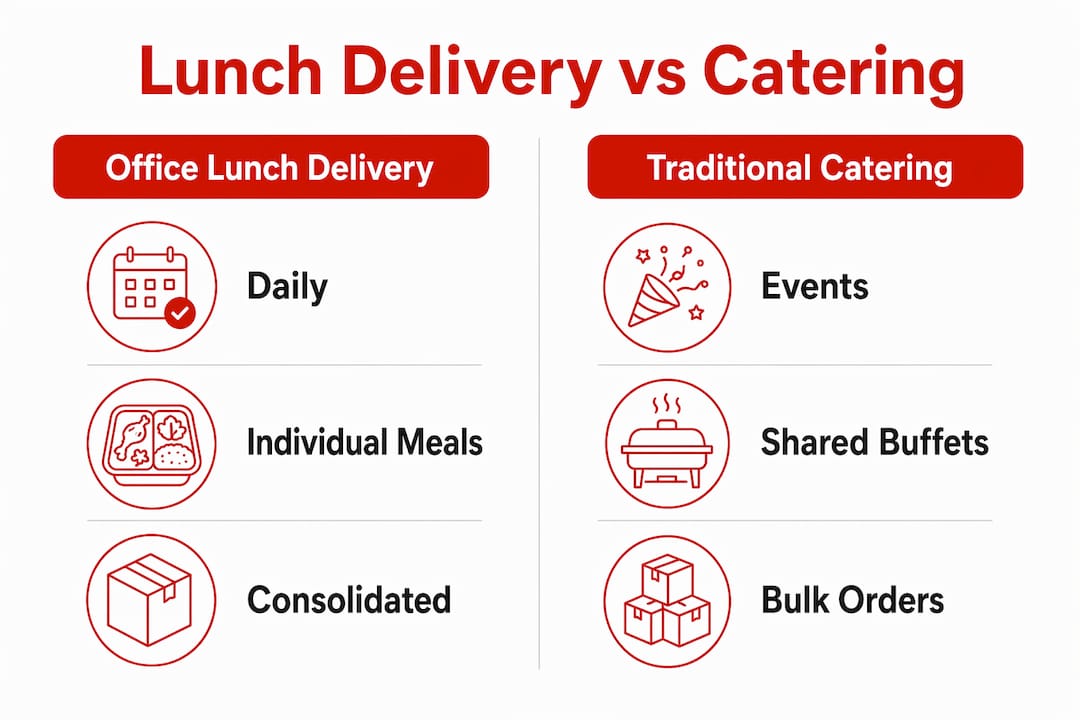
The difference between office lunch delivery and traditional corporate catering comes down to frequency, scale, and personalization. Catering is designed for events: bulk-prepared food, shared platters, and a fixed menu chosen by one person for everyone. Lunch delivery is designed for daily use: individual meals, personal choices, and menus that reflect the actual preferences of the team.
| Feature | Office lunch delivery | Traditional catering |
|---|---|---|
| Frequency | Daily or recurring | Event-based |
| Meal format | Individually portioned | Shared platters or buffet |
| Menu selection | Each employee chooses | One person orders for all |
| Waste management | Participation-based ordering | Fixed bulk quantities |
| Health and safety | Sealed, per-person packaging | Open shared serving |
| Setup complexity | Minimal, digital ordering | Requires on-site setup |
Individually packaged meals reduce cross-contamination risks that shared buffets carry. That matters in any office environment, but it became a hard requirement for many teams after 2020. The sealed, portioned format also means meals stay at the correct temperature longer, which is a practical advantage over open platters that cool quickly.
Catering still has its place for large events, client presentations, and company celebrations. For daily or weekly team lunches, though, the delivery model wins on flexibility, waste reduction, and ease of setup. Teams using corporate lunch delivery in London report that the shift from catering to delivery cut their per-person food cost and removed the need for a dedicated person to manage the order.
Why does office lunch delivery improve workplace culture?
Office lunch delivery programs enhance employee satisfaction by giving each person control over what they eat, which removes the frustration of a shared menu that never quite works for everyone. Dietary restrictions, allergies, and personal preferences are handled at the individual level rather than as an afterthought. That respect for personal choice has a measurable effect on morale.
The benefits for office managers are equally significant. Manual preference collection, payment reconciliation, and delivery coordination disappear when a digital platform handles all three. An office manager who previously spent 45 minutes organizing a team lunch can redirect that time to higher-value work. The administrative relief alone justifies the switch for most teams.
Group meal experiences also strengthen team cohesion. When a team eats together at the same time, even if each person chose a different meal, the shared ritual creates a natural break that encourages conversation outside of project contexts. Research in workplace behavior consistently links shared mealtimes to stronger team relationships and higher reported job satisfaction.
- Menu variety: Employees choose from multiple cuisines and dietary options, including vegetarian, vegan, and gluten-free.
- Dietary tracking: Digital platforms record individual requirements and flag allergens automatically.
- Reduced downtime: A single consolidated delivery means no one leaves the office to find food.
- Scalable ordering: Flexible daily ordering accommodates hybrid teams where attendance changes week to week.
- Cost transparency: Flat-rate or per-person pricing makes budgeting predictable for finance teams.
Pro Tip: Rotate the menu monthly to prevent fatigue. Even a small change in available options keeps participation rates high and prevents the “same sandwich every Tuesday” problem.
How to choose the best office lunch delivery service for your team
The best office lunch delivery service for your team depends on five criteria: menu range, delivery reliability, cost structure, technology features, and scalability. Evaluating each one before committing saves time and avoids switching costs later.
Menu range and dietary coverage matter more than most teams expect. A service that covers sandwiches, hot meals, salads, and dietary variants (vegan, halal, gluten-free) keeps participation high. Low participation defeats the purpose of group ordering.
Delivery reliability is non-negotiable. Consistent delivery personnel who know the office layout and schedule reduce coordination friction significantly. Ask any prospective service how they handle late deliveries and what their on-time rate looks like.
Cost structure requires careful reading. Look for flat-rate group pricing rather than per-delivery fees that stack up. Theofficelunch, for example, uses group pricing for platters that reduces the per-person cost as headcount grows. Factor in any platform fees, minimum order requirements, and tip policies before comparing quotes.
Technology features determine how much administrative work the service actually removes. The platform should handle dietary tracking, payment collection, and order confirmation without requiring manual input from the office manager. If you still need a spreadsheet to run the program, the technology is not doing its job.
Scalability is the criterion most teams overlook until they need it. A service that works for 10 people should also work for 50, and it should handle days when only 6 people are in the office without penalizing you for the reduced order. Participation-based ordering is the feature to look for here. You can also review guidance on setting a catering budget to build a realistic cost model before you commit to a recurring plan.
Key Takeaways
Office lunch delivery is the most practical daily food solution for teams because it combines individual choice, consolidated logistics, and participation-based ordering to cut waste and administrative effort simultaneously.
| Point | Details |
|---|---|
| Core model | Employees order individually; all meals arrive in one consolidated delivery. |
| Waste reduction | Participation-based ordering means food is prepared only for employees present. |
| Catering vs. delivery | Catering suits events; delivery suits daily or recurring team meals. |
| Health advantage | Individually sealed meals reduce cross-contamination compared to shared buffets. |
| Choosing a service | Prioritize menu range, delivery reliability, flat-rate pricing, and scalability. |
What I’ve learned from watching offices get lunch delivery right (and wrong)
The teams that get the most out of office lunch delivery are not the ones with the biggest budgets. They are the ones that treat it as a system rather than a perk. The distinction sounds small, but it changes everything about how the program runs.
The most common mistake I see is treating the first delivery as a test and the second as a commitment. Teams order once, have a good experience, and then let the program drift because no one owns it. Lunch delivery works best when one person, usually the office manager or an EA, takes five minutes each week to confirm the delivery window, check the menu, and send the ordering link. That is the entire administrative overhead when the service is set up correctly.
The hybrid work shift made this more complicated and more necessary at the same time. When attendance fluctuates, a fixed catering order becomes wasteful fast. Participation-based ordering solves that problem directly, but only if the team actually uses it. I have seen offices pay for 20 lunches on a day when 12 people showed up, simply because no one updated the order. The technology exists to prevent that. Use it.
The other thing worth saying plainly: quality matters more than variety. A service with six menu options that executes perfectly every time beats a platform with 40 restaurant choices and inconsistent delivery. Teams stop using programs that let them down twice. Find a service with a track record, check real testimonials, and prioritize reliability over novelty.
— Efe
Theofficelunch: office lunch delivery for London and Surrey teams
Theofficelunch has served London and Surrey offices since 2015 with a model built around reliability, fresh food, and group pricing that makes daily delivery financially practical.

The menu covers fresh sandwich platters and individual meal options designed for meetings, team lunches, and recurring office programs. Dietary requirements are accommodated across the range, and flat-rate group pricing keeps per-person costs predictable regardless of team size. Delivery arrives on time, at the correct temperature, with no administrative overhead for the team managing it. If your office needs a dependable lunch program in London or Surrey, Theofficelunch is built for exactly that.
FAQ
What is the difference between office lunch delivery and catering?
Office lunch delivery focuses on daily, individually portioned meals ordered by each employee, while catering provides bulk-prepared food for events. Delivery suits recurring team lunches; catering suits one-off occasions.
How does participation-based ordering reduce food waste?
Participation-based ordering means meals are only prepared for employees who have confirmed attendance. This eliminates over-ordering and the cost of food that goes uneaten.
Can office lunch delivery work for hybrid teams?
Flexible daily ordering accommodates teams with changing attendance, so you only pay for the meals actually needed on any given day. This makes it a practical fit for hybrid schedules.
What should I look for in a recurring lunch delivery plan?
Prioritize flat-rate group pricing, dietary tracking technology, and a proven on-time delivery record. A service that handles payment collection and order confirmation digitally removes the most time-consuming administrative tasks.
Is office lunch delivery available in London?
Theofficelunch provides corporate lunch delivery across London and Surrey, with fresh sandwich platters and individual meal options suited to offices of varying sizes.
Recommended
- Office lunch delivered to offices – Sandwich platters – Office Lunch – Catering company-Party food
- Corporate lunch delivery London – Sandwich platters – Office Lunch – Catering company-Party food
- The best office lunch in London – Sandwich platters – Office Lunch – Catering company-Party food
- Lunch platters delivered to your door – Sandwich platters – Office Lunch – Catering company-Party food